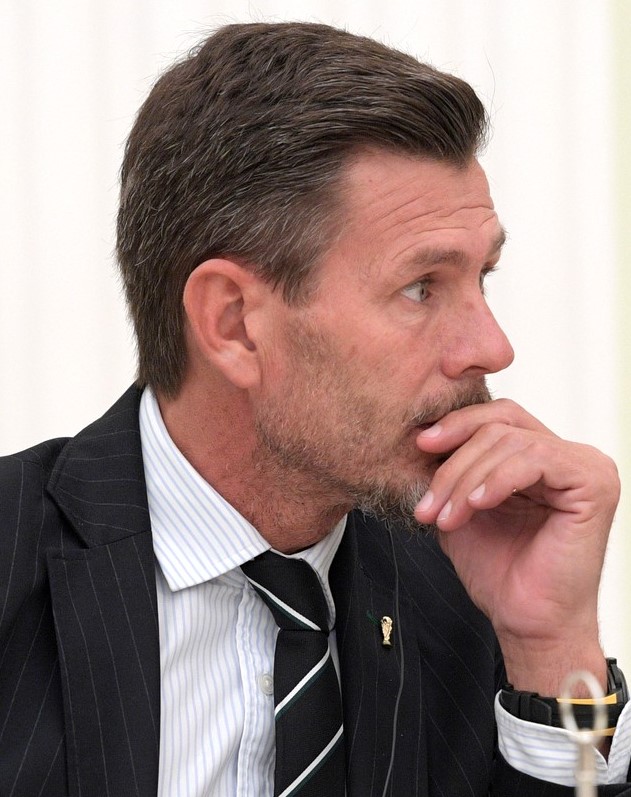
Zvonimir Boban was born on October 8, 1968 in the city of Imotski (today Croatia, then SR Croatia in SFR Yugoslavia) in the family of Marinko and Marija Boban. Father Marinko was a soccer player and one of the founders of the Imot club NK Mračaj; He brought the sons of Dražen and Zvonimir to training sessions from nearby Imotski every day. After the scouts of Hajduk from Split estimated that young Zvonimir was not good enough, the family sold a house in Imotski in 1983 and moved to Zagreb so that the sons could play for Dinamo Zagreb. Boban played for Mračaj at the age of ten; The first big field he met was the stadium in Runovići, and he often emphasizes that it was this “fighting area” that shaped his character.
Key details from early life:
- Date of birth: October 8, 1968.
- Place of birth: Imotski, SR Croatia, SFR Yugoslavia.
- Moving to Zagreb: The family moved in 1983 so that sons could train in Dinamo.
- First club: NK Mračaj Runović, where most of his family played alongside Zvonimir.
- Education: After his career, he graduated in history in 2004 at the Faculty of Philosophy of the University of Zagreb, with the topic “Christianity in the Roman Empire”.
football career
Dinamo Zagreb
Boban made his debut for Dinamo Zagreb in 1985/86, when he was only 16 years old. In six seasons, he played 109 games and scored 45 goals. At the age of 19, he became the youngest captain in the history of the club. The match between Dinamo and Crvena zvezda on May 13, 1990 was marked by riots in the stands; Boban stood up for the fans and hit the militiaman, for which he was suspended and expelled from the Yugoslav national team for the World Cup in 1990. The incident later became a symbol of resistance and Croatia’s desire for independence.
AC Milan and Serie A
In the summer of 1991, AC Milan bought Boban; Due to restrictions for foreign players, he first sent him on loan to Bari. The following season, he returns to Milan, where he will stay for ten years and become one of the key players in the middle of the field. With Milan, he won four Italian championship titles and the Champions League in 1994, and in the 1994 European Super Cup he scored the leading goal against Arsenal. In total, he played 251 games for Milan and scored 30 goals. In August 2001, due to the arrival of Rui Costa, Celti Vigo was loaned; Dissatisfied with the role of the reserve, he terminates his contract and retires in October 2001.
international career
Boban won the 1987 World Cup in Chile with the Yugoslav national team, scoring three goals and realizing a decisive penalty in the final. He made seven appearances and one goal for the senior national team of Yugoslavia.
After Croatia’s independence, he joined the new national team and made his debut in a friendly match against Romania on December 22, 1990. With the captain’s armband, he led the team at the 1996 European Championship and the 1998 World Cup, where Croatia wins third place. During the World Cup, he stood out with an assist for Davor Šuker’s goal in the match for third place against the Netherlands. He played 49 official matches for Croatia and scored 12 goals.
Farewell to football
Due to the lack of minutes at Celta Vigo, Boban arbitrarily broke his contract in 2001 and said goodbye to his professional career. In October 2002, he organized a farewell meeting in Zagreb where football legends performed, and the Maksimir Stadium was sold out.
Postplay and Administrative Career
study and media
After finishing his career, Boban devoted himself to his family and academic education. He graduated in history in 2004 at the Faculty of Philosophy in Zagreb. He worked as a commentator and analyst on Italian television for years Sky Italia and Croatia RTL television, and wrote columns for the Italian Diary La Gazzetta dello Sport. He was the CEO of Sports Dnevnik Sports news.
FIFA
On May 30, 2016, the International Football Federation (FIFA) appointed Boban as deputy general secretary for football. In this capacity, he worked on the development of the competition and was one of the main proponents of the introduction of video assistants to the judge (VAR). During the 2018 World Cup in Russia, he stayed in Moscow and collaborated with Pierluigi Collin and Massimo Busacco on the education of judges. He left FIFA in June 2019, and President Gianni Infantino thanked him for his contribution.
Return to AC Milan
In June 2019, AC Milan hired Boban as Chief Football Officer, a close associate of technical director Paolo Maldini. He was dismissed from the club on March 7, 2020, after publicly criticizing the CEO Ivan Gazidis for negotiating with coach Ralf Rangnick without the knowledge of the sports sector.
UEFA and resignation
In April 2021, the European Football Federation (UEFA) appointed Boban as the first Chief of football in the history of the organization. In January 2024, he resigned due to President Aleksander’s intention to change the statute so that he could remain in office even after three consecutive terms. In an open letter published in Croatian media Telegram, Boban wrote that accepting such a decision would be against his values; He emphasized that he does not want to participate in a move that he considers “fatal” for the institution. UEFA thanked Boban for his contribution and confirmed that they parted ways by agreement.
Return to Dinamo Zagreb
In April 2025, GNK Dinamo Zagreb announced that Boban was returning to the club as CEO (CEO). At the press conference, they confirmed that they will take office from June 1, 2025 and that they will manage the club’s sports policy. For the presentation, he thanked the previous executive director Zvonimir Manenica and the president Velimir Zajec, pointing out that the club’s trust is a special honor for him. In an interview with the British Guardian In December 2025, Boban said that returning to Dinamo was an emotional decision and the last stop of his football career and that rejecting that opportunity would be considered a betrayal of his own values.
personal life
Boban has been married for many years to Leonardo Lončar (fashion designer). The couple met in 1989, they had a civil wedding in Milan in 1993, and the church celebration in Zagreb on June 11, 1994. They tried for years to have children and are:
- 1997. adopted the little girl Maria.
- 2003. adopted the boy Gabriel.
- 2007. adopted the twins Martha and Raphael.
- 2009. had a biological daughter, Ruža.
The family lived in a Zagreb house until 2016, and then moved to Zurich because of Boban’s job. After 28 years of marriage, the couple announced in 2021 that they lived separately, but in January 2024 they reconciled. Leonarda then stated that they are “now more mature and friends” and that they are enjoying their life together again. In the same interview, she recalled that they had never officially divorced and that the children support them.
Boban is 1.83 meters tall, and he likes to spend his free time playing tennis with his friend Goran Ivanišević. According to his own words, he never wants to be a coach because of the “nervous that work brings”.
public interest and searches
Zvonimir Boban has become a symbol of the struggle for autonomy and football exceptionalism in Croatia and beyond. His blow to the militiaman in 1990 in Maksimir is still interpreted as an act of defiance against repression. As the captain of the national team that won the world bronze medal in 1998 and as one of the most successful Croatians in AC Milan, Boban has a cult status. His return to Dinamo in 2025 attracted a lot of attention from fans and the media, and interviews like the one in Guardian They emphasize that this is a man of clear principles and willingness to leave high positions when he does not agree with the administration.
FAQ (FAQ)
How old is Zvonimir Boban?
Boban was born on October 8, 1968. At the time of writing the article (January 2026), he has 57 years.
What is his height?
According to official statistics of the portal National Football Teams, Boban is tall 1,83 m.
Why is Zvonimir Boban famous?
Boban is known as one of the greatest Croatian footballers. He was the captain of Dinamo and the Croatian national team, he won four Italian championship titles and the Champions League with AC Milan, and led Croatia to third place at the World Cup in 1998. He is also known for the incident in Maksimir in 1990, which became a symbol of resistance.
Who is Zvonimir Boban’s wife?
His wife is Leonarda Lončar, a fashion designer with whom she has been married since 1993/1994. years. After the separation in 2021, the couple reunited in 2024 and they point out that today they have a more mature and friendly relationship.
How many children do Zvonimir and Leonarda have?
They have five children: adopted daughter Marija (1997), adopted son Gabriel (2003), adopted twins Marta and Rafael (2007) and biological daughter Ruža (2009).
When and why did he leave UEFA?
In 2021, Boban became Chief of football in UEFA, and in January 2024 he resigned because he opposed President Aleksander Čeferin’s plan to change the statute so that he could remain in office for longer than the prescribed 12 years. In an open letter, he explained that accepting such a proposal would be contrary to his moral principles.
When did he become the president of Dinamo Zagreb?
In April 2025, the club announced that Boban would take over the position of President of the Management Board (CEO) and manage Dinamo’s sports policy. His tenure began 1. June 2025..
What is he doing today?
Since June 2025, Boban has been leading GNK Dinamo Zagreb. In the conversations, he points out that it is his last and most emotional engagement and that he wants to return the club to the fans.
What is his property (Net Worth)?
Boban’s income and assets have not been made public. There are no official estimates of his net wealth in the media, so information about Net Worth remains unknown.
Is he active on social networks?
Boban is known for his private life and does not actively use social networks. It has official profiles (eg on X/Twitter), but publishes very rarely; He mainly conducts communication with the public through interviews and official channels of the club.
Conclusion
Zvonimir Boban remains one of the most charismatic Croatian athletes. From the poor region of Imot and NK Mračaj to the captain’s armband of Dinamo and the Croatian national team to a role in international football institutions, his career is characterized by talent, courage and clear moral principles. Currently, as the president of Dinamo Zagreb, he continues to influence Croatian football and remains a figure of great interest to the public.
Cover photo: Kremlin.ru, CC BY 4.0, Via Wikimedia Commons