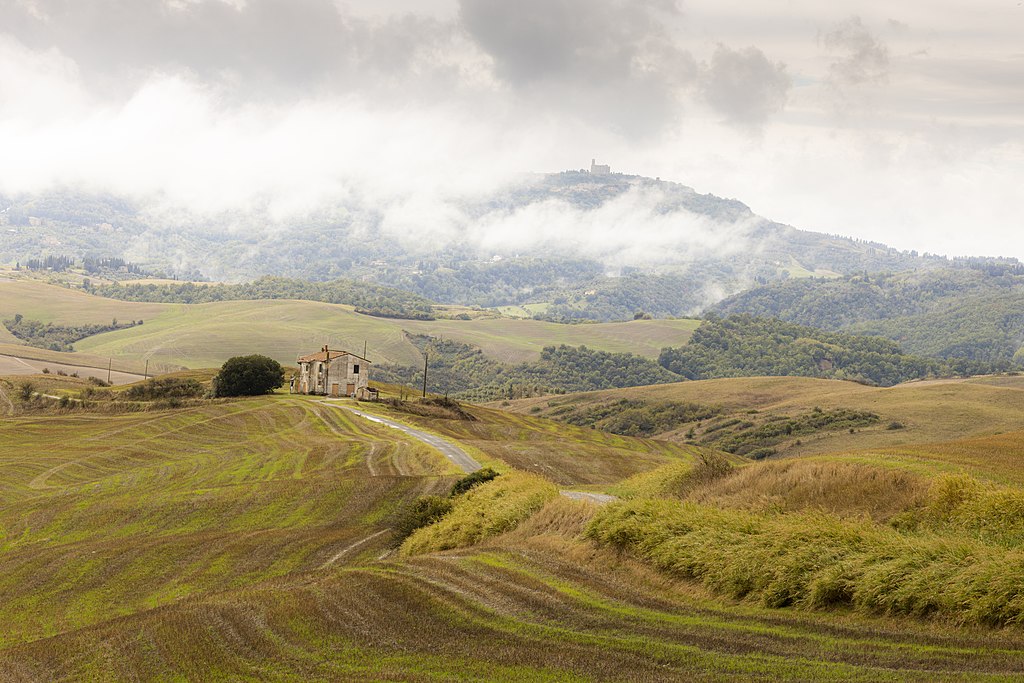
Tuscany – country houses and vineyards are scattered about the hills, and their approaches are lined with long alleys of cypress trees. Visitors enjoy a typically Italian flair – and swimming here is offered more than the Mediterranean itself.
Where is the ‘black abbot’? The full moon hangs low on the horizon, the ruins of the Abbey church tower over the night sky like a secret carved in stone. Now all that is needed is the sound of a female penetrating cry and the atmosphere of Edgar Wallace’s novel would be perfect. But this is not England; This is southern Tuscany – and that is exactly why no night visitor to San Galgano Abbey has to be afraid of meeting a killer in a monk’s suit behind the next pillar. The very thought of that, however, is enough to make a person feel uncomfortable – especially since there are no other visitors in sight.
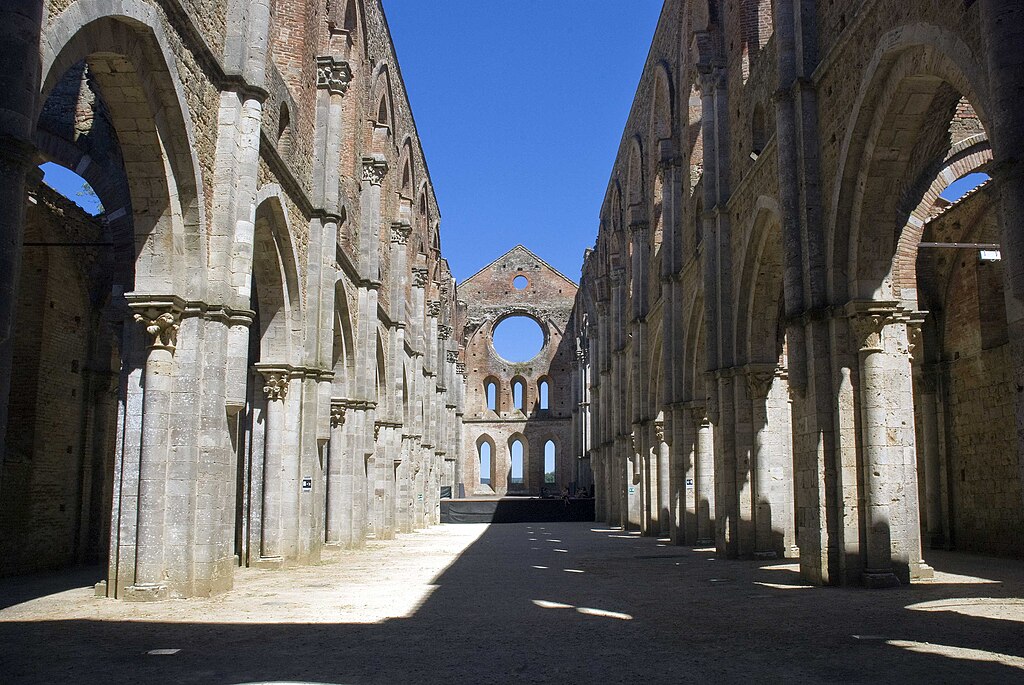
To call San Galgano an insider’s advice would be to deliberately deceive tourists. The spacious parking lot in the middle of the country landscape clearly shows what can sometimes happen here during the peak of the season. However, before and after summer, few tourists disperse around the locality – not only in the evening, when the ruins are effectively lit, but also during the day.
The hidden discoveries of the south of Tuscany – a journey through history and landscape
While in Siena, only 30 kilometers away, tourists line up to visit Piazza del Campo, San Galgano Abbey proves that journeys of discovery throughout southern Tuscany pay off.
San Galgano was once a Cistercian monastery. The hermit Galgano Guidotti died here in 1181, and a large Gothic ship in the middle of the field was built in 1218. The monks, however, were not happy here for a long time; The last of them went to Siena as early as 1474. The roof of the church was removed in the 16th century, the rest collapsed, and in 1786 the tower was destroyed by a lightning strike – and the ruins that tourists see today were completed.
Tuscany as a fairy tale – vineyards, villages and medieval towns
South of Siena there are also the main ‘M’ of southern Tuscany: Massa Marittima, Montalcino and Montepulciano. They are all connected by another ‘m’: the Middle Ages. In Montepulciano, the old city walls remained completely intact, which allows the city to present itself as a cohesive unit. Numerous stores sell leather goods, ceramics and wine. The main wine of the city is ‘Nobile de Montepulciano’, a robust red wine that must be aged in wooden barrels for at least two years.
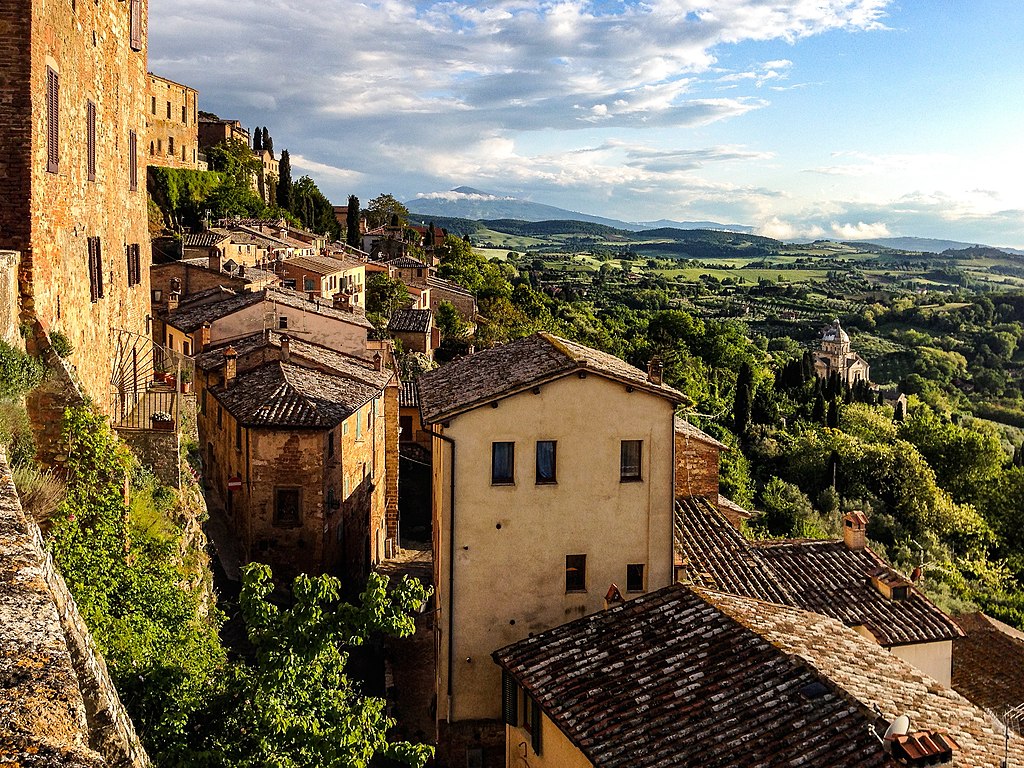
Montepulciano lies in the heart of Crete Senesi, a landscape of wheat fields and clay hills dotted with isolated country houses, with approaches bordered by long cypress alleys – this is a picturesque Tuscany which so many people are looking for.
We continue towards Montalcin, the hills are now becoming a little greener: winemaking determines the lives of many people, and here the top product is called ‘Brunello’. Only on selected vineyards can vines grow this red wine, which must then be aged in wooden barrels for at least four years. At the Enoteca in Montalcino, ‘Brunello’ is currently on a special offer: the 1999 vintage costs 45 euros per bottle, while other wines cost 120, 280 euros or even more.
From the hills to the sea – the Tuscan coast within easy reach
As we continue towards the Mediterranean, the landscape changes again: from Crete we enter the Maremma, a sparsely populated, but all the more green region full of hills. It used to be an orphanage in Tuscany – and it still applies. Many villages are deserted, most of the windows are closed. It is worth stopping longer in Massa Maríttimi. And this city has a center located on a hill with narrow streets, historic palaces and excellent restaurants. It is worth seeing the almost 1000 year old Cathedral on Piazza Garibaldi, with a wide open staircase.
The coast is not far away now; The city of Castiglione della Pescaía, with its old town located – how else? – On the hill, it is especially popular. At noon in the off-season, there is almost no one; Only a few two-stroke scooters from the neighboring alley disturbs the silence. From the fortress walls, on a clear day, the view reaches all the way to the island of Elba – and even on foggy days, far beyond the beaches of the region.
Saturnie waterfalls – natural warm baths in the heart of Tuscany
In Saturnia, an hour’s drive from the sea, you can enjoy a different type of swimming. The name sounds like a celestial realm, but in reality it is like a meeting with the devil: a hot sulfur source of temperature of 37.5 degrees flows over the waterfall into small pools, over which the stench of rotten eggs spreads – which hardly deters tourists from diving.
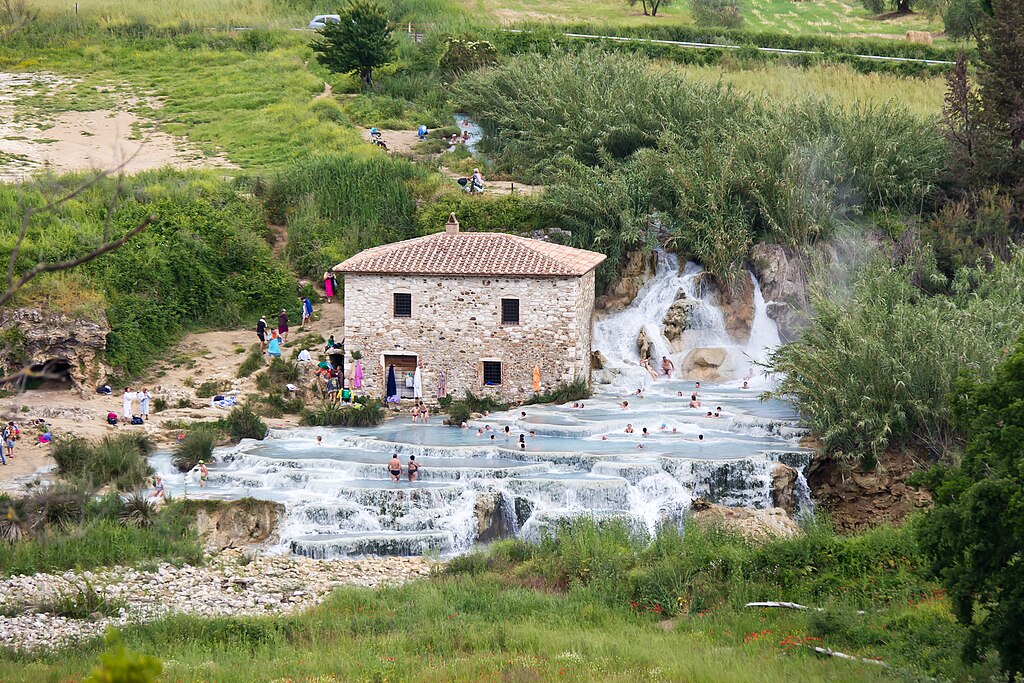
Those who appreciate the shower and clothes cabinet will find ‘Terme di Saturnia’ two kilometers away, which are powered by the same source. A daily ticket here costs as much as 22 euros.
But one thing always remains, no matter where you bathe: the smell of sulfur on your skin, which no shower can remove. Even late in the evening, when you visit San Galgano Abbey, your body stinks like a meeting with the Devil’s Grandma. Is this perhaps the reason why the ‘black abbot’ does not appear?
Cover photo: Radek Hloch, CC BY-SA 4.0, Via Wikimedia Commons