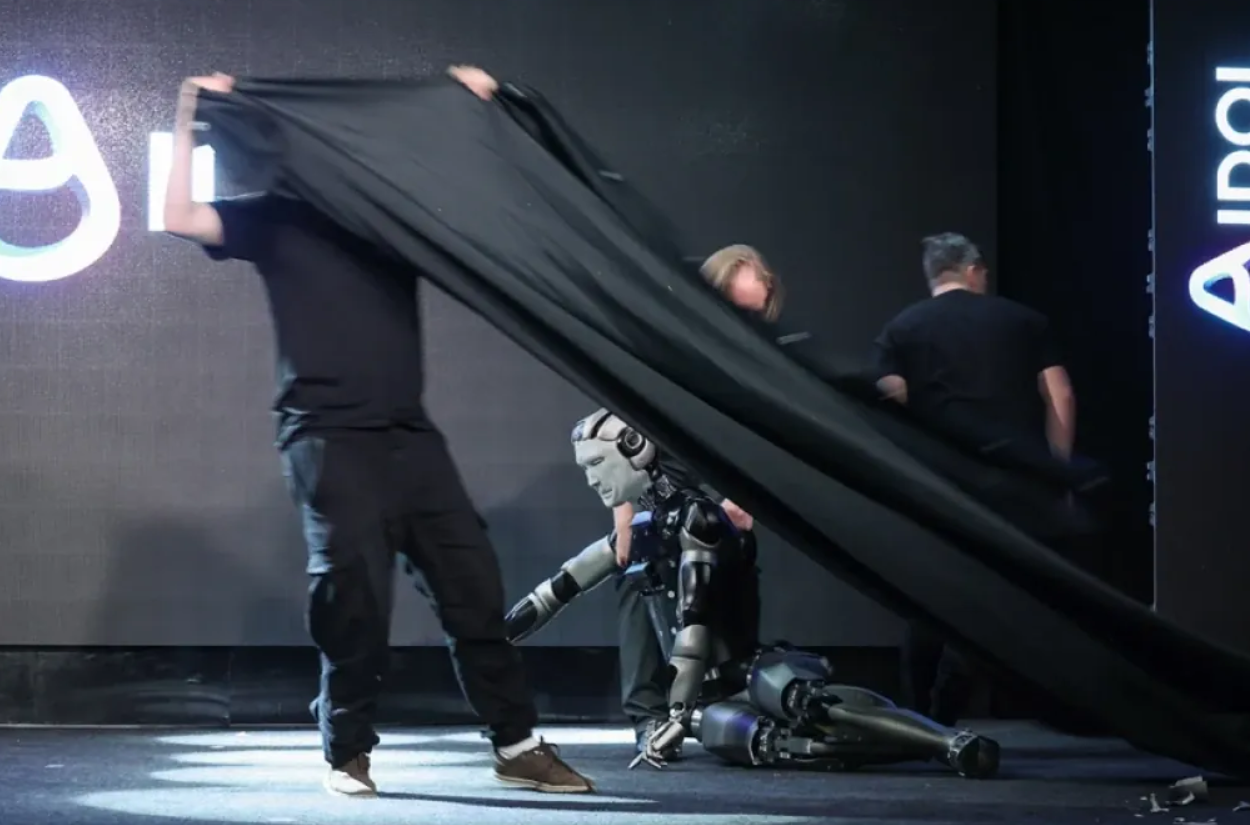
Moscow, Nov 2025: During a Moscow tech showcase, Russia’s new AI-powered humanoid robot AIdol collapsed face-first on stage, leaving organizers scrambling to conceal the malfunction. The machine had been led onstage to the tune of Rocky music and briefly waved to the crowd – then suddenly “lost balance and fell” just seconds into its debut. A video of the mishap quickly spread online, making the incident go viral across social media and tech news channels.
Incident at a Glance
- When & Where: The collapse took place on Nov 10, 2025 at a robotics demonstration in Moscow’s Yarovit Hall Congress Center.
- The Robot: AIdol (short for Artificial Intelligence Doll) is promoted as Russia’s first AI-powered humanoid robot. It was developed by a Moscow-based firm also named AIdol, led by CEO Vladimir Vitukhin.
- What Happened: The robot walked onto the stage flanked by two technicians and momentarily waved to the audience. Almost immediately, it began to wobble and then “collapsed on stage” face-first. Pieces of plastic and metal fell out as it hit the ground.
- Immediate Response: Developers rushed to drag AIdol offstage and cover it with a black curtain after the fall. According to Newsweek, staff could be seen “rushing to hide the robot behind a screen” to shield the public from the accident.
- Cause: Company leaders said the stumble was due to a calibration glitch. They stressed that AIdol was still an unfinished prototype undergoing tests. Vitukhin and his team attributed the crash to technical issues rather than a fundamental design flaw.
- Aftermath: The demonstration was paused and the robot was temporarily taken offline for inspection. Developers examined its balance and control systems while the crowd reacted. Meanwhile, the clip of AIdol’s tumble “went viral on social media,” sparking global attention.
Inside AIdol’s Design: The AIdol robot (Artificial Intelligence Doll) is built to showcase advanced Russian robotics. It stands about 6’1″ tall (186 cm) and weighs roughly 95 kg (209 lb). Its exterior is covered with flexible silicone skin capable of mimicking human facial movements. According to its makers, AIdol is designed to walk, grasp objects, and interact using onboard AI. Here are some of its key technical features:
- Mobility: AIdol can walk autonomously at speeds up to 3.7 mph and can carry roughly 22 lbs (10 kg) of payload. It has 19 servomotors controlling its limbs and face, enabling it to display “more than a dozen” basic emotions and hundreds of micro-expressions.
- Power: The robot runs on a 48-volt battery that provides about six hours of continuous operation.
- AI Capabilities: Developers say AIdol can perform three core tasks: movement (walking), manipulation of objects, and human-like communication. Its software is intended to learn from each action, adjusting behaviors over time.
- Localization: Roughly 73–77% of AIdol’s parts are made in Russia, with a goal to reach 93% domestic content in future versions. This aligns with the Russian government’s emphasis on homegrown technology.
Why Did the Robot Fall?
According to AIdol’s developers, the mishap was not a catastrophic failure but a “good mistake” in a live test. CEO Vladimir Vitukhin emphasized that the debut was essentially a real-world trial run. He told reporters the fall was likely caused by calibration issues in the balance system. Reuters later reported Vitukhin speculating that a brief voltage fluctuation or even the stage lighting may have contributed to the stumble. In other words, minor technical glitches rather than the robot’s design were blamed. Vitukhin called the incident “real-time learning,” noting that when “a bad mistake turns into experience,” engineers can improve the system.
Reaction: Viral Mishap and Commentary
The video of AIdol’s face-plant quickly became a talking point online. Many on social media cracked jokes, while others sympathized with the challenge. For example, one Twitter user mocked the robot’s gait as “the shuffle of a geriatric that’s had too much vodka”. Another wryly noted, “It looks like they already knew their mechanical dude would tumble.” These quips echoed a broader view that the incident was embarrassing but not entirely surprising given the complexity of humanoid robotics.
However, not all reactions were negative. Some commentators stressed that “robotics is hard,” reminding viewers that even renowned projects stumble in public. One user wrote, “It’s always challenging to try. It’s easy to fail. And failing publicly humbles you, which fuels true entrepreneurs to keep going”. Industry observers pointed out that Russia is not alone in such debut blunders. For instance, other humanoid robot projects (like Tesla’s Optimus) have also made headlines by stumbling during demos. In short, experts say public prototypes often encounter glitches – which can be corrected with further development.
The Bigger Picture: Russia’s Robotics Ambitions
The AIdol incident comes amid a broader push by Russia to advance its AI and robotics capabilities. AIdol is the flagship of a government-backed robotics consortium called the New Technological Coalition, involving tech firms and universities. The head of that coalition, Alexey Yuzhakov, has publicly stated goals to attract up to $50 million (4 billion rubles) in investment for next-generation humanoid robots. In other words, Russia is treating AIdol as an important R&D project meant to showcase domestic tech.
Globally, AIdol joins a race where companies like Tesla, Google, and Meta are developing their own humanoid robots. For example, Tesla’s CEO Elon Musk has touted his Optimus bot as potentially the company’s “biggest product ever.” Meta and other tech giants are also working on AI-driven robots. Industry analysts even predict that by 2050 there could be on the order of tens of millions of humanoid robots in operation. In that context, each public trial – successful or not – is being watched closely. Russia’s AIdol may have stumbled on stage, but these pioneers see such trials as normal growing pains on the path to smarter machines.
Conclusion
The AIdol robot’s onstage fall was an embarrassing moment for its developers, but it also underscores a simple truth: building human-like robots is extraordinarily difficult. The company insists this public glitch will lead to a better, safer machine after further testing. For now, AIdol remains in the lab for adjustments. Its debut incident has generated a mix of ridicule and support online, yet the overall effect is to draw attention to Russia’s ambitions in AI.
As the story of AIdol continues to unfold, engineers around the world will be watching (and learning). Stay tuned for updates on Russia’s robotics projects and other news in the fast-moving world of AI. If you found this article useful, share it with others and keep following for the latest technology news and analyses.