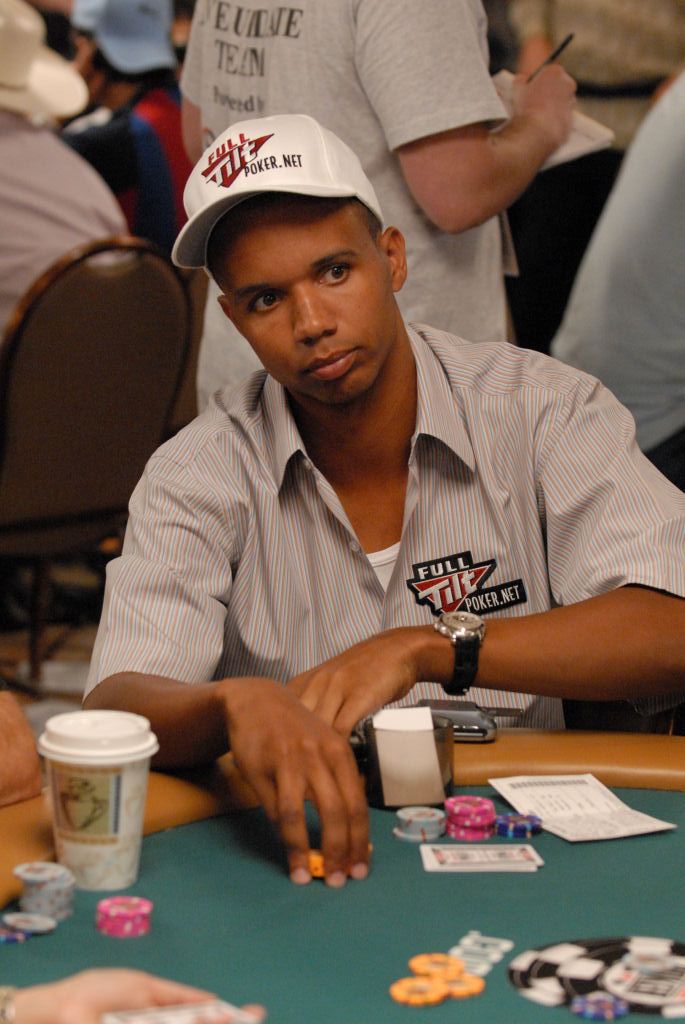
Phil Ivey (pictured) is known for his intense focus and record-breaking poker career. Phil Ivey (born February 1, 1977) is an American professional poker player widely regarded as one of the greatest in the game. Over his career he has won 11 World Series of Poker bracelets and a World Poker Tour (WPT) title, achievements that earned him induction into the Poker Hall of Fame in 2017. Nicknamed “No Home Jerome” (for sneaking into Atlantic City at 17 with a fake ID) and “The Tiger Woods of Poker,” Ivey has built a reputation on mastery across every poker format. His biography is a story of early obsession with cards, relentless study, and historic wins that continue to inspire players worldwide.
Early Life and Poker Beginnings
Phil Ivey was born in Riverside, California, but was raised by his grandparents in Roselle, New Jersey from infancy. His grandfather taught him Five-Card Stud at around age eight, planting the seeds of a lifelong passion for poker. Ivey sharpened his skills playing informal games as a teen – even using a fraudulent ID to enter Atlantic City card rooms. Locals noticed the young player was “always at the table,” earning him the nickname No Home Jerome. By his late teens he was working in telemarketing and playing the card games with coworkers for practice. Even early on, Ivey treated poker like a discipline: studying opponents’ patterns in low-stakes games, learning the math of each variant, and turning every loss into a lesson. This intense training ground – nightly sessions in Atlantic City cash games – prepared him for the global stage.
Poker Career and Major Achievements
Phil Ivey’s career is defined by jaw-dropping accomplishments. He burst onto the big tournament scene by winning his first WSOP bracelet in 2000 (Pot-Limit Omaha) at age 23. Within two years he claimed three WSOP bracelets in one summer (2002), tying the modern record for most wins in a single series. Over the next two decades, he added bracelets in a variety of poker variants – Omaha, Stud, Razz, H.O.R.S.E. and more – finally capturing his 11th at the 2024 WSOP (2-7 Lowball Triple Draw). Remarkably, all 11 of Ivey’s bracelets have come in non-Hold’em events, underscoring his mastery of mixed games. In tournament play he has also won a World Poker Tour championship (the 2008 L.A. Poker Classic) and made numerous final tables, placing him among the legends of the game. As of 2024, his live tournament earnings exceed $45 million – landing him 12th on poker’s all-time money list – and he held the spot of #2 on the WSOP bracelet leaderboard (behind Phil Hellmuth) after 2024.
- WSOP Bracelets (11): Ivey’s 11 gold bracelets span 2000–2024, all in mixed-game events. (First in 2000; 3 in 2002; his most recent in 2024).
- World Poker Tour (WPT): Winner of the 2008 L.A. Poker Classic (first place $1,596,100).
- Poker Hall of Fame: Inducted in 2017, cementing his status as a poker great.
- High-Stakes Feats: In a 2006 showdown with billionaire Andy Beal, Ivey won $16.6 million playing heads-up Limit Hold’em over three days – one of the largest recorded cash-game wins.
- Career Earnings: Over $45 million in live tournament cashes, reflecting decades of top-level success.
These concrete successes – a record matched by few – answer any question about Ivey’s skill. He has been a constant presence in the late stages of major events and remains a feared opponent in any format.
Phil Ivey’s playing style is as legendary as his results. He is famous for a near-silent, stone-faced approach: he rarely chatters or displays emotion at the table. Observers note that Ivey “stares, observes, calculates – and then strikes with precision”. He virtually never uses gimmicks like sunglasses or hoodies to bluff opponents; instead his confidence comes from reading others and choosing perfect spots to bet. Ivey’s calm demeanor is often described as giving him a “sixth sense” – opponents have no tells to read, creating an aura of mystery around his thought process. Crucially, Ivey excels in all poker forms: from Pot-Limit Omaha and Stud to the mixed games of H.O.R.S.E. and 8-Game Mix. Many experts consider him the greatest all-around player in history due to this versatility.
Throughout his career he has focused heavily on study and practice. He has publicly shunned heavy reliance on computer solvers in favor of instinct and experience – a throwback to reading opponents rather than just playing math. His style thrives in deep-stack, high-pressure situations, where his keen memory and observation give him an edge. In televised cash games like High Stakes Poker and Poker After Dark, Ivey’s presence stole the show: opponents were visibly unnerved by his silence and timing.
Controversies: Edge-Sorting Disputes
While Ivey’s tournament resume is stellar, his biography also includes high-profile controversies. In 2012 and 2014, Ivey was involved in legal battles over large baccarat winnings at casinos. Both incidents centered on edge sorting – a technique of exploiting tiny irregularities on card backs to gain an edge in card games In London. (Crockfords Casino, 2012) he won £7.7 million ($12M) playing Punto Banco, but the casino refused to pay the full amount, citing his method of having the dealer rotate high-value cards. Similarly, in 2014 the Borgata Casino in Atlantic City sued Ivey after he and a partner won $10 million at baccarat. The Borgata claimed breach of contract and sued for $15.6 million (including $10M of winnings).
- Crockfords (London, 2012): Ivey won roughly £7.7M but was paid only his £1M ante. The casino refused the rest, arguing Ivey’s “edge-sorting” technique amounted to cheating. Ivey denied wrongdoing, but UK courts ultimately agreed with Crockfords, ruling that his actions violated casino rules.
- Borgata (Atlantic City, 2014): Using the same edge-sorting method, Ivey won $10M. Borgata sued for $15.6M; U.S. courts held Ivey had breached Nevada gaming regulations. By 2016 a federal judge ordered Ivey to repay over $10M, and in 2019 federal marshals even seized his WSOP winnings to satisfy that judgment.
In both cases, appeals failed – even the UK Supreme Court in 2017 backed the casinos. While Ivey continues to insist he did nothing fraudulent, these disputes remain a notable chapter in his life, frequently asked about by fans and critics alike.
Personal Life and Philanthropy
Off the felt, Phil Ivey is famously private. He lived in Las Vegas for much of his career and has kept a low profile on social media. He married wife Luciaetta in 2002; they divorced in 2009. Ivey has no children publicly known. He enjoys sports – an avid fan of the NBA’s Lakers and Houston Rockets – and hobbies like golf and sports betting outside poker.
Despite his intense focus on poker, Ivey has quietly given back to community causes. In 2008 he donated $50,000 to Empowered 2 Excel, a Las Vegas charity for underprivileged youth, and soon after founded the Budding Ivey Foundation in honor of his grandfather. This foundation has raised funds (for example, ~$260,000 in 2008) to support education and children’s programs. He has also partnered with Make-A-Wish to create memorable casino experiences for kids.
In business ventures, Ivey has turned his expertise into opportunities for others to learn. He created Ivey Poker (a play-for-fun app) and Ivey League (a poker training site). In 2019 he even launched a Phil Ivey MasterClass, teaching strategy, mental game, and hand analysis to students – a rare case of poker education straight from one of the all-time greats. Through these efforts he shares his approach (calm concentration, precision, adaptability) with aspiring players.
Conclusion
Phil Ivey’s journey – from a young card hustler in New Jersey to a Hall-of-Fame poker titan – is a testament to skill, dedication, and fearless ambition. He has redefined excellence in poker by mastering every game variant and setting records that stand today. While his edge-sorting disputes drew controversy, they have done little to tarnish the respect he commands among peers. Ivey’s legacy is seen in the countless players who study his play and in the way every major tournament now reveres the name “Ivey” as a mark of supreme competence.
Whether you are a poker enthusiast or just curious about extraordinary careers, Phil Ivey’s biography offers lessons in discipline and innovation. Those looking to learn from the legend can explore Ivey’s strategy in his MasterClass or by reviewing footage of his most famous hands. Stay tuned to the poker world: Phil Ivey remains an active figure in tournaments and cash games, continually adding to the legacy of “poker’s final boss.”
Cover photo: Photo by flipchip / LasVegasVegas.com, CC BY-SA 3.0, via Wikimedia Commons