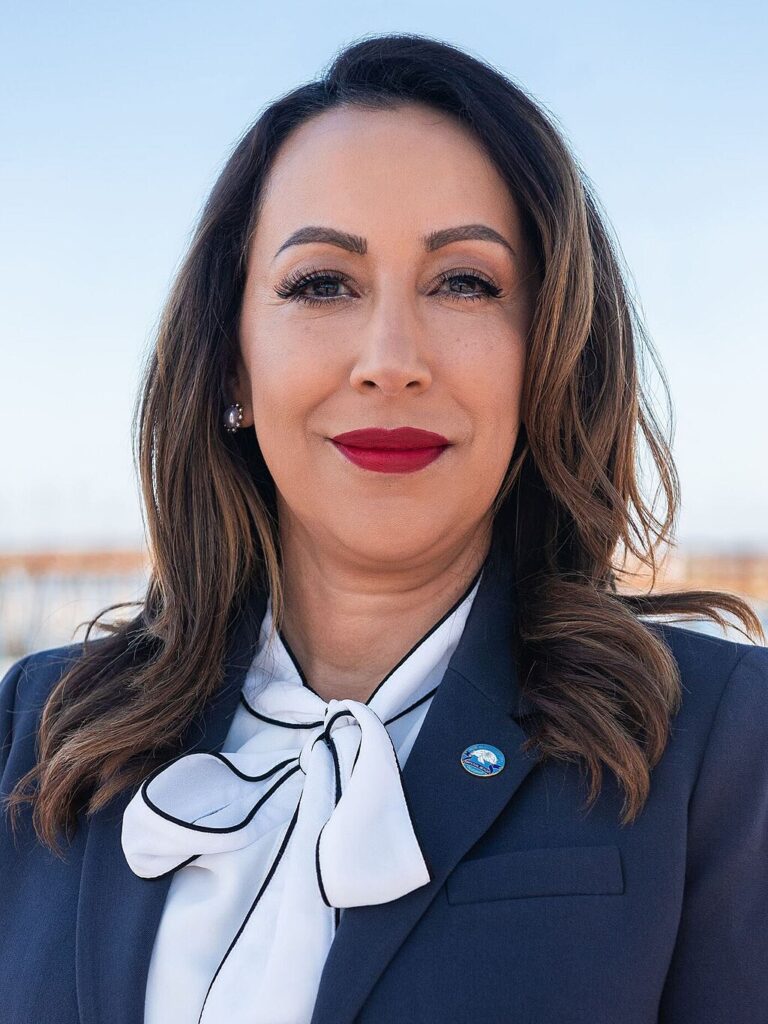
Paloma Aguirre is a California conservationist and Democratic politician known for her long fight against cross-border pollution and her rise from community organizer to San Diego County Supervisor. Born in San Francisco to Mexican immigrant parents and raised partly in Puerto Vallarta, Mexico, she later earned degrees from the University of San Diego (B.A. in Psychology) and UC San Diego’s Scripps Institution of Oceanography (M.S. in Marine Biodiversity and Conservation). As an athlete, she taught herself to surf and became a competitive bodyboarder – even winning trophies in men’s divisions – a hobby that deepened her love for the coast.
Key Facts at a Glance
- First-Generation Mexican American: Born in San Francisco; spent childhood years in Puerto Vallarta, Mexico.
- Education: Bachelor’s degree from University of San Diego; Master’s in Marine Conservation from UCSD Scripps. First in her family to graduate college.
- Environmental Leader: Worked 10+ years at Wildcoast (a coastal conservation nonprofit) fighting sewage and pollution in the Tijuana River Valley. Named California Assembly’s 2014 Woman of the Year for her restoration work in the Tijuana River.
- Local Politics: Elected to Imperial Beach City Council in 2018 – the first Latina in that seat – and then Mayor of Imperial Beach (2022–2025). As mayor she pressed state and federal agencies to fix the South Bay sewage crisis.
- County Supervisor: In July 2025 she won a special election to join the San Diego County Board of Supervisors (District 1), again making history as the first Latina from Imperial Beach in that role. She now serves as Chair Pro Tempore under a new, women-led board leadership team.
Early Life, Education and Activism
Paloma Aguirre’s family moved back to Mexico when she was 8 years old, giving her a bilingual, binational upbringing. In 2001 she returned to San Diego for college, surfing and bodyboarding at Imperial Beach. “The surf was clean and the community was welcoming,” she recalled, saying the beach’s waves and people made her “fall in love” with Imperial Beach. After graduating from USD, she earned additional training in nonprofit management and completed her master’s degree in marine conservation at UCSD Scripps.
Aguirre spent years as a community organizer, helping low-income families in south San Diego with issues from foreclosures to immigration. She then devoted herself to environmental conservation, joining Wildcoast (then based in Imperial Beach) to tackle sewage and pollution flowing from Tijuana into the U.S. coastal zone. In her view, the Tijuana River was “one of, if not the most polluted, river in the entire United States,” a crisis she has called “one of the worst environmental crises in the country”. Colleagues note that Aguirre “has spent two decades tackling” this sewage problem – long before she held public office. Her grassroots work earned statewide recognition: in 2014 she was honored as an Assemblywoman’s “Woman of the Year” for restoring the Tijuana River Valley.
These recurring pollution floods exemplify the hazards Aguirre has fought. In her campaigns she has championed “open, clean beaches” as a basic goal. She has vowed “I won’t stop until the toxic sewage crisis is fixed for good”, underscoring her long battle on this issue. As a result, she helped secure hundreds of millions of dollars in federal funding (including over $150 million from the EPA) to upgrade the aging South Bay International Wastewater Treatment Plant – a key step toward cleaner water for her communities.
Imperial Beach City Council and Mayoralty (2018–2025)
Aguirre’s activism naturally led her into local politics. In 2018 she won a seat on the Imperial Beach City Council – the first Latina ever elected to that body. There she focused on environmental justice and economic equity for frontline communities. In 2022 she ran for and won Mayor of Imperial Beach, again becoming that city’s first Latina mayor. Her tenure as mayor was dominated by the sewage and pollution crisis. Aguirre pushed tirelessly for a binational solution to cross-border waste, lobbying state and federal leaders. One example: a 2025 letter from Mayor Aguirre to Congress helped prompt President Biden to allocate $156 million for the Border Wastewater Treatment Plant, part of a multi-year push (on top of earlier appropriations) to fix the broken system. She celebrated the $600 million recently approved by Congress for border-area water projects, citing it as proof that Imperial Beach – often dismissed as “too small” – could deliver results.
Key achievements as Mayor: Under her leadership Imperial Beach upgraded flood warning systems, secured $150+ million in federal grants for wastewater infrastructure, and maintained attention on issues like housing and park funding for a low-income community. She also represented the city on regional bodies such as the San Diego Community Power Board and California Coastal Commission. Throughout, Aguirre highlighted her identity as a first-generation college graduate and daughter of immigrant parents – “I’m proud to be the daughter of immigrants who came to America and worked long hours,” she reminded audiences – to underline her commitment to working families.
San Diego County Supervisor (2025–present)
When Nora Vargas resigned from the County Board of Supervisors in early 2025, Aguirre ran in the special election for District 1. In July 2025 she defeated Chula Vista Mayor John McCann (53.9% to 46.1%), again making history as the first Latina from Imperial Beach to serve on the Board. She took office on July 22, 2025, amid a largely Democratic board. In her victory speech Aguirre promised to bring her relentless energy to county issues. “District 1 residents now have a fighter at the County Board of Supervisors,” she said, declaring that voters had spoken “loud and clear: clean up the sewage crisis, lower costs and stand up to the chaos…coming out of Washington.”.
As a supervisor, Aguirre was quickly chosen as Chair Pro Tempore of the Board (with Terra Lawson-Remer as Chair and Monica Montgomery Steppe as Vice Chair) for 2026. Her early actions include co-sponsoring resolutions on food assistance and immigration reforms, and working to preserve community spaces (like the Tijuana River Valley Community Garden) under county stewardship. She also joined Joel Anderson in calling for a thorough review of $2.2 billion in county contracts, reflecting her attention to fiscal oversight. All the while, Aguirre continues to prioritize her original causes: at her swearing-in ceremony she emphasized housing, open beaches, parks, and public safety as her top priorities, and reaffirmed “I’ve been fighting this [sewage] for years” as part of her ongoing agenda.
Impact, Legacy and Future Focus
Paloma Aguirre’s biography is defined by a blend of grassroots advocacy and political leadership. She has repeatedly broken barriers (first Latina in two local offices) and translated her environmental passion into concrete results. Her career illustrates how a local leader can elevate community issues to the regional and national stage – for example, letters she sent as Imperial Beach mayor helped bring federal attention (and funding) to the border sewage crisis. Colleagues praise her as “an inspirational leader” with “tenacity and vision” for working families.
Key focus areas today include: clean water and air for South Bay residents, affordable housing, and protecting immigrant and labor rights. The Times of San Diego notes that Aguirre “has spent two decades” tackling environmental threats to Southern San Diego. As a county supervisor, she combines that environmental lens with broader policy goals like fiscal accountability and social equity. In concrete terms, she is pursuing remaining cleanup funds for the Tijuana River, expanding transit and energy projects in her district, and pushing for regional solutions to homelessness.
Paloma Aguirre’s story – from surfboards to City Hall to County government – shows how dedicated community action can lead to real power and change. Readers interested in her ongoing work can follow news on San Diego’s Board of Supervisors or visit her official site for updates. Aguirre herself urges engagement: whether on neighborhood conservation projects or local elections, she reminds us that “the power to change our community for the better is in our hands”. (After all, she did it by organizing people and winning races – perhaps inspiring others to do the same.)
Conclusion: Paloma Aguirre remains a hands-on leader focused on practical solutions. From securing millions in infrastructure funding to leading the Board of Supervisors, her career exemplifies a “people-first” approach. As she often says, making South Bay neighborhoods healthier and more equitable is a fight “she will continue fighting every day”. For readers, her example highlights the impact of staying engaged on local issues: informed communities and determined officials together can bring about real change.
Cover photo: City of Imperial Beach, California, Public domain, via Wikimedia Commons