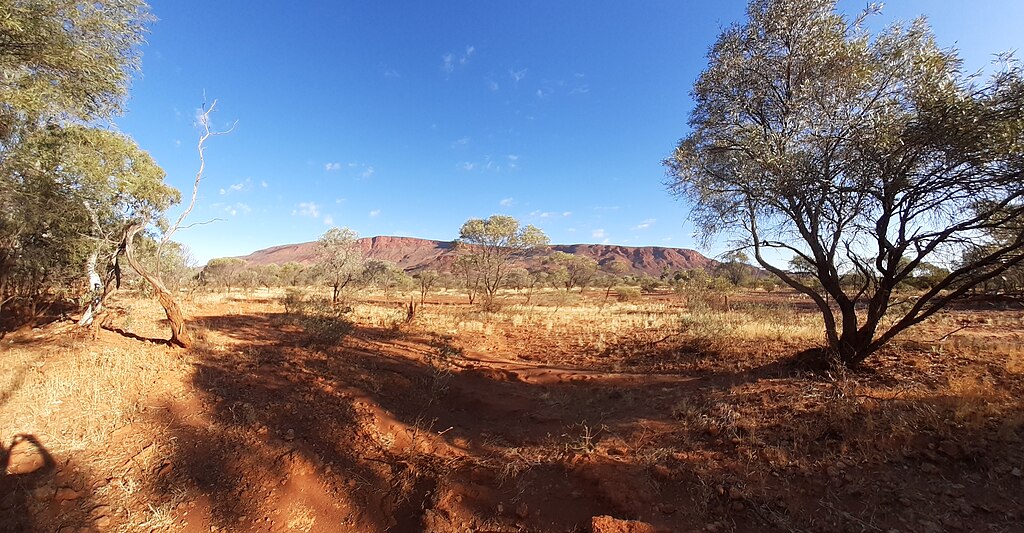
Unlike Ayers Rock, Mount Augustus is the largest rock in Australia. For some, the journey may seem tiring. But this is exactly what makes the visit so appealing.
When you think of the Australian wilderness, Ayers Rock quickly comes to your mind. Like a giant ship with a keel, the red rock rises from the desert. However, Ayers Rock is not the biggest attraction of its kind: about 1,600 kilometers west is Mount Augustus in Western Australia, a very similar mountain, but two and a half times larger. Here, however, the influx of visitors is acceptable: the place is too far from Australian tourist routes, and the journey seems too strenuous. And yet, that’s exactly what makes the visit so attractive.
It’s 6:26 in the morning, and it cooled down a bit overnight. The thermometer shows only 29 degrees Celsius, and the Sun has not yet risen above the horizon. Anyone who wants to climb Mount Augustus has to get up early; By noon at the latest, the heat becomes too strong for any strenuous physical effort. And the climb is anything but a walk in the park: a good three hours, partly a steep, climbing sky. It must be overcome 650 meters above sea level, at first with a lamp in hand, and then in the shadow of the mountain. ‘Summit Trail’ is located on the west side of the mountain, which rises 1106 meters above sea level.
No sound, no animal
The backpack weighs heavily on the shoulders, mostly filled with water bottles. At least two liters per person are allowed for the ascent, and in the end it seems to be quite scarce. The air here is very dry, especially when, like today, the wind blows from the east, from the direction of hot Australian deserts.
Soon, the sun peeks out from behind the top for the first time, and the thermometer quickly rises to 35 degrees Celsius. There is no sound, no animal is seen, and no plane leaves traces of steam in the sky. Only a few flies buzz around the mountaineers, and the warm east wind causes acacia to quiver – unlike Ayers Rock, Mount Augustus is covered with bushes and trees all the way to the top.
Too hot to touch
Halfway through, my shirt and face are wet with sweat. There are no other mountaineers nearby – just like the day before when I was driving here from the shore. A good 450 kilometers without traffic from the opposite direction – when does this ever happen? In a four-wheel drive vehicle, we were able to reach a speed of up to 110 kilometers per hour on wide, well-maintained sandy tracks. Across the town of Gascoyne Junction, the journey first led to Kennedy Ranges National Park, another attraction in this part of Australia. There were no other tourists here either who wanted to see things like Honeycomb Gorge, a gorge with a steep wall at the end, shaped by erosion like honeycomb.
At noon in Honeycomb Gorge there was a good 41 degrees Celsius, rocks too warm to the touch. Today, the thermometer is likely to return to that range, but the peak of Mount Augustus will soon be reached – long before the midday heat. From above, the landscapes of the hinterland take on a completely new appearance: red and brown soil are mixed; Where lakes form after rain, tall green grass grows. And the river beds, almost none of which carry water throughout the year, are clearly visible thanks to eucalyptus, a special type of eucalyptus, which border both banks.
stains on the floor
The small stone pyramid marks the highest point of the mountain, and the entry book at the top is waiting for enrollments. It helps determine when the season is here: during the colder season in Australia, from May to October, mostly locals climb. Then, in November, the picture changes: Germans, Swiss, Poles – visitors from half of Europe – but there are only a few a day, and sometimes no one comes at all for weeks. There was no entry from January 13 to February 16, 2007. It was too warm during those weeks.
It’s 9:25 AM now, it’s time to go down before the heat gets too strong. The trails are well marked with stains of paint on the ground and pink ribbons in the bushes, including ‘Gully Trail’, another route leading upwards. It runs parallel to the ‘Summit Trail’, leads through a dry stream and has some very steep parts – it’s not for mountaineers who think they’ve already sweated enough.
Aboriginal rock drawings
We reached the parking lot before the sun reached its highest point; The journey in both directions took five hours. Now it’s time for a quick shower – or at the state’s Cobra Station 25 kilometers away, which offers a ‘farm vacation’, or at the Mount Augustus tourist resort, with its 20 small cabins, a restaurant, a campsite and a telephone booth. This place has had a bad reputation for a while due to the large number of drunks who visited it. ‘Since the 2006 administration change, that’s no longer a problem,’ assures Mike Flood, the regional representative for tourism of Western Australia in Carnarvon. Instead, the cows from the neighboring ranch come to graze the grass from the irrigated lawn at night, and the little frogs jump on the walls of the toilet and showers.
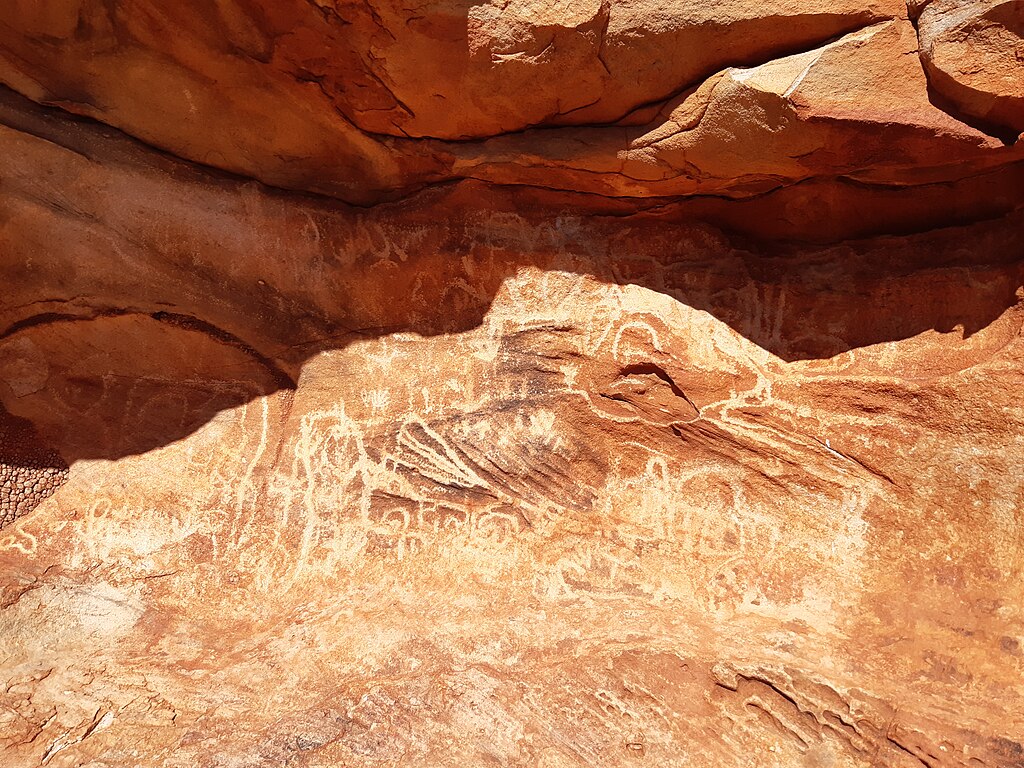
Ayers Rock can be walked around on foot in a few hours, but Mount Augustus would last much longer. The 49-kilometer circle runs around the Red Rock, with Aboriginal drawings on the rocks found in several places. They are quite small and ‘are more of an artwork,’ says Mike Flood. ‘They show that the living conditions here were and are much harsher than, for example, in Kakadu National Park in the far north of Australia. There is plenty of food there, and there was also time for artistic drawings on the rocks. Here, with a bit of luck, there was one kangaroo monthly, the result of a long hunt.’
The tour to the northwest leads to the Emu Hill viewpoint, a hill with a magnificent view of Mount Augustus. By now, evening has fallen, and the sun paints the rock with a darker red color. There is no sound, no animal is seen – and there are no tourists who use their digital cameras to the limit. In this secluded place, the traveler feels like one with a mountain and land. A long journey, a painstaking approach – it was worth it.
get there:
Mount Augustus, approximately eight kilometers long, is located 430 kilometers east of the coastal town of Carnarvon in the hinterland of Western Australia. The ride takes at least six hours on mostly unpaved roads. Four-wheel drive is an advantage, but travel is also possible by rented car. Carnarvon is located 900 kilometers north of the city of Perth on the Indian Ocean.
Air conditioning and travel time:
The Australian summer (December to March) is very hot, with frequent thunderstorms. The optimal travel time is from April to October.
Cover photo: Calistemon, CC BY-SA 4.0, Via Wikimedia Commons