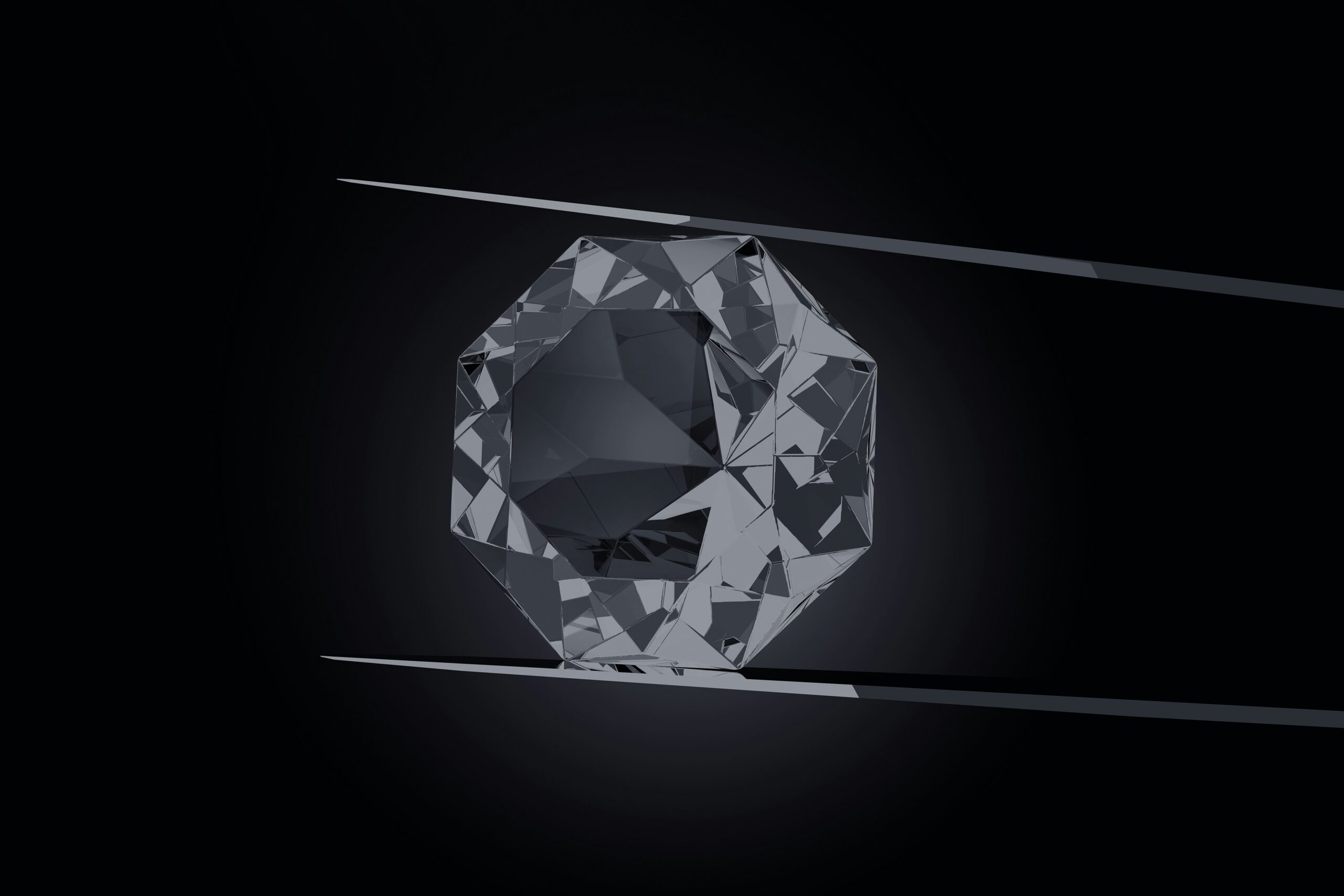
Diamonds are prized for their sparkle and hardness, but with high value comes a risk of imitations. Whether you’re inspecting a loose gem or a diamond ring at home, it’s wise to know the telltale signs of a real diamond versus a simulant or fake. In this guide, we’ll walk through easy at-home tests and inspection tips, as well as professional methods, to help you determine if your diamond is genuine. We’ll cover everything from visual cues (sparkle and setting) to simple DIY tests (fog, water, dot tests, etc.). Remember, while these methods can give clues, the most reliable confirmation always comes from a certified gemologist or lab report. Use these tips to get a good idea of authenticity, and when in doubt, seek a professional evaluation.
Diamond vs. Simulant: Know What You’re Testing
First, understand what “real” means here. A real diamond can be either natural (mined) or lab-grown, as both are chemically identical forms of crystalline carbon. Lab-created diamonds have the same hardness and optical properties as natural ones, so most home tests cannot tell them apart. In fact, as GIA notes, lab-grown diamonds “are real diamonds… You cannot spot a synthetic diamond by looking at it through a loupe. The only way to tell is by laboratory testing”. Our focus is distinguishing any form of diamond (natural or lab) from non-diamond imitations.
Common diamond simulants and imitations include:
- Cubic zirconia (CZ) – a glass-like synthetic that’s cheaper, heavier, and disperses light differently (more “rainbow” fire).
- Moissanite – a very hard lab-made gem that looks similar but has higher dispersion (more colored sparkle) and different electrical properties.
- White sapphire, white topaz, glass, quartz – some natural or man-made stones that can resemble diamonds at a glance.
Each has slightly different physical and optical traits, which the tests below will target.
2. Quick Visual Inspection: Sparkle, Facets and Setting
Before any test, start with a good look. Real diamonds interact with light in distinctive ways, but keep in mind many other gems can also sparkle.
Brilliance vs. fire: A real diamond will reflect bright white brilliance (sharply-reflected white light) with a hint of colored fire (rainbow flashes). When you hold a diamond under a lamp, it should give off intense flashes of white light. Simulants often look different – for example, cubic zirconia tends to produce an abundance of rainbow colors, making it look “too flashy.” As Blue Nile explains, “a real diamond usually has sparkle in shades of gray with intense light. Compared to diamonds, moissanite will have a rainbow sparkle”. In other words, too much rainbow flash can be a red flag for CZ or moissanite.

A close-up of a solitaire diamond engagement ring. Notice the bright white sparkle (brilliance) and subtle colored flashes (fire) from the gemstone.
Facet edges and shape: Look at the cut edges under magnification if you can. Diamonds are cut precisely, so their facet junctions should be crisp. However, note that many gemstones – natural or synthetic – can also have sharp facets. GIA points out that the myth “a real diamond will have sharp edges, a fake won’t” only applies to really poorly-made imitations (like molded plastic). Even real diamonds can have tiny nicks or “abraded facet junctions” from normal wear. Similarly, some antique settings have mixed metals, so metal quality alone isn’t definitive.
Setting and hallmarks: Genuine diamonds are typically set in high-quality metals. Check the piece for marks like 10K, 14K, 18K, PT, Plat, or numbers like 585, 750, 950 – these indicate gold or platinum. A cheap metal (silver or gold-plated base metal) can be a hint the stone is not valuable. Real diamonds often come in solid gold or platinum settings. That said, a fancy setting doesn’t guarantee authenticity either (a clever scammer could use a good setting on a fake). Still, an unmarked or low-quality band is a clue to be cautious.
Inclusions and blemishes: Most real diamonds have tiny natural inclusions (“birthmarks”) or slight color tints. If you look with a loupe or magnifier and see straight-out reflections, that can happen with any clear stone. But GIA notes that a perfectly flawless, “too-perfect” stone is rare and might be synthetic or CZ. Conversely, actually spotting inclusions is tricky for non-experts – so don’t rely on absence of inclusions as proof of fakery. Use magnification more as a supporting check (discussed later).
Putting it together: None of these visual clues alone proves authenticity, but they set expectations. A very dull, matte gem is unlikely to be a polished diamond. Likewise, a ring with no hallmarks or a flimsy setting is suspect. If the gem’s sparkle or setting just feels off, proceed to testing.
3. Simple At-Home Diamond Tests
If visual checks leave doubt, try these easy experiments. Remember: none is 100% foolproof, but they can quickly signal if further investigation is needed. Perform tests gently and carefully (especially if the diamond is set) and do them in good light.
- Fog (Breath) Test: Breathe on the stone like a mirror. Real diamonds disperse heat very quickly, so the fog from your breath should vanish almost immediately. If it stays fogged for a few seconds, that suggests it may be a simulant. However, this test can mislead: even real diamonds fog up briefly, and humidity affects it. GIA cautions that condensation tests are inconsistent. Use it only as a quick clue, not a definitive answer.
- Water (Density) Test: Fill a glass with water and drop in the loose stone (or a removable stone). Because diamond is very dense, a real diamond will sink straight to the bottom quickly. Less-dense simulants (glass, plastic, zircon) may float or sink slowly. (Note: Moissanite is also dense and will sink, so this test mainly helps separate out light imposters.) Do not damage the setting – remove the stone first if possible.
- Dot/Newspaper Test: This checks refractivity. On a piece of paper, draw a black dot or letter. Place the stone flat over it and look down through the top. A genuine diamond’s high refractive index will bend light away, making the dot hard or impossible to see. A fake (glass/CZ) usually lets you see the dot or printed lines clearly because it bends light less. For a mounted ring, try the same with newspaper print, though be cautious not to press or scratch the gem.
- Flashlight/Mirror Test: Hold the stone to a mirror or shine a bright light through it. Real diamonds scatter light intensely. In a dark room, a diamond’s reflection in a mirror looks like a bright white circle. If the light reflection is very dull or you see a clear reflection (not fuzzy), it might be fake. A useful trick: turn off other lights and shine a small flashlight through the stone into the mirror. Diamonds will give off a sharp, white sparkle; cubic zirconia often appears more grayish inside. (This is similar to the sparkle check above.)
- Ultraviolet (UV) Test: Many diamonds exhibit fluorescence under UV (black) light, often showing a blue glow. If you shine a UV light and see medium-to-strong blue fluorescence, the stone could be a diamond. Other colors like green or gray are unusual and may hint at a non-diamond. But lack of fluorescence does not mean it’s fake (about 30% of diamonds have none). This is only a suggestive test and varies by diamond.
- Sunlight Test: Take the gem outdoors or near a bright window on a sunny day. Watch its sparkle in natural sunlight. A real diamond will burst into bright white flashes and subtle spectral colors as it moves. If it looks comparatively dull or shows garish, repeated rainbow bursts, question it.
- Thermal Conductivity (“Diamond Tester”): Special handheld diamond testers use a heat probe to measure thermal conductivity – diamonds dissipate heat quickly. If you have a tester pen, follow its instructions: it will usually beep or give a reading indicating “diamond” if the stone conducts heat like one. This is a reliable quick test for diamond vs non-diamond. Caution: Moissanite also conducts heat similarly, so a standard thermal tester will call moissanite “diamond.” A separate electrical conductivity tester can then distinguish moissanite from diamond.
- Scratch Test (Not Recommended): Some advise scratching glass with the gem, since diamond is hardest (10 on Mohs scale) and won’t scratch. Do not try this! It can damage your stone or setting, and many imitations can also resist scratching. GIA strongly warns that using sandpaper or scratching is destructive and not advisable.
Summary of At-Home Tests: These DIY tricks (fog, water, dot, sparkle, UV, testers) can give clues but should not be solely trusted. If any basic test shows a negative sign (e.g. gem floats in water, fog lingers, sparkles weirdly), treat the stone with suspicion. Ideally, try several different tests. Ultimately, the only certain way to verify is professional evaluation.
Examining with Magnification
Using a jeweler’s loupe (10× magnification) or a good magnifying glass can reveal more details:
- Inclusions and Imperfections: Under a loupe, look for tiny internal specks, feather-like inclusions, or needle-like minerals inside the stone. Most natural diamonds have some such inclusions. If you see any, it suggests authenticity (though note, some imitations have gas bubbles or swirl marks that are different in appearance). On the other hand, if the stone appears absolutely flawless under magnification, it could either be a top-grade diamond (rare and expensive) or a synthetic/gemstone. Don’t rely solely on this: a flawless result can happen with a lab-grown diamond or a well-crafted simulant.
- Facet and Flame Test: Rotate the stone under light. Genuine diamonds have extremely sharp facet junctions and a certain way light “flashes.” Moissanite, for example, is double-refractive, causing each facet’s reflection to break into a doubled image (look for tiny “doubling” on facets). CZ often shows a blurry edge at a facet junction. Also, real diamonds emit a distinct white flame-light reflection; simulants may show more rainbow. This is subtle and best for experienced eyes.
- Ultraviolet Checker (Loupe): Some jewelers use a special eyepiece that can identify moissanite by its double refraction (under a polariscope) or test gem hardness with a microscopic touch. At home, you probably won’t have these, but simply seeing gas bubbles under magnification means the stone is likely glass.
Using a Loupe: If you have a diamond tester (thermal) and a loupe, you can gather a lot of information. But be cautious: as GIA notes, an untrained person can easily be misled by reflections and facet lines. Many genuine diamonds have minor surface scratches or abrasions, and some lab-created stones are included to mimic real ones. In summary, a loupe can support other tests: it’s more evidence toward “real” rather than a standalone check
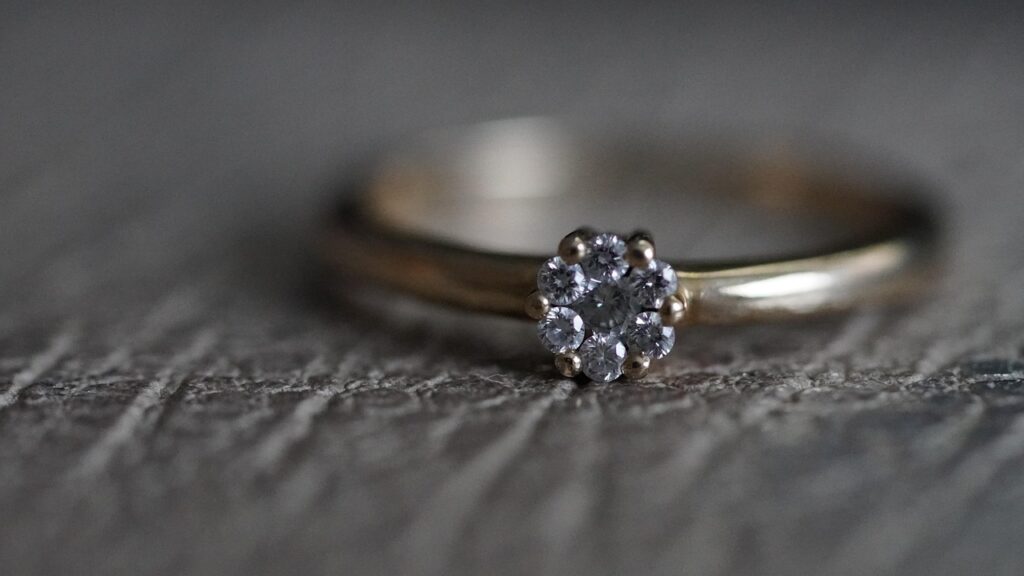
A magnified view of a diamond cluster ring. Under magnification, a jeweler would look for tiny inclusions or characteristic facet reflections. Most real diamonds have minute internal flaws; a perfectly clear stone might be lab-grown or a simulant.
Professional Testing and Certification
The only completely reliable confirmation of a real diamond is through professional grading. Certified gemological labs (like GIA, AGS, IGI, etc.) have precise instruments to test chemical composition, crystal structure, and optical properties. They can tell if a diamond is natural or lab-grown, and differentiate all simulants.
- Certification: Always ask if the diamond comes with a grading report or certificate. A GIA report, for example, not only describes the 4Cs (Cut, Color, Clarity, Carat) but unequivocally identifies the stone as a natural or synthetic diamond. Most reputable diamonds for sale will have a certificate. You can even use GIA’s online report check with the report number to verify authenticity.
- Jewelers and Appraisers: A qualified jeweler or gemologist can perform quick electronic tests (like advanced diamond testers that distinguish moissanite) and optical inspections. If you’re uncertain about a stone, take it to a trusted jeweler. They can often tell within minutes and give you written assurance.
- Return Policy: If buying new, ensure there’s a clear return or certification policy. Reputable sellers allow you to return or verify with an independent lab. This protects you if the diamond turns out to be misrepresented.
Conclusion
Distinguishing a real diamond from a fake or simulant can be tricky with the naked eye, but a combination of methods helps build confidence. Key at-home checks include looking for the characteristic white brilliance, testing density (water test), and trying simple tricks like the dot or fog test. Remember that sparkle alone isn’t foolproof – many gems sparkle, and the setting or metal quality are just clues, not proof.
If any test raises doubt – for example, the stone floated in water or showed excessive rainbow fire – err on the side of caution. Ultimately, the most reliable step is to consult a professional. A gemologist’s review or lab report will definitively tell you if your diamond (or diamond ring) is real. But using the above tips, you can often spot a suspicious stone quickly and know when to get expert help.
Next Steps: If you’re buying a diamond ring or have a piece to verify, try some of the at-home tests above first. If it looks genuine but you want certainty, bring it to a certified jeweler for an appraisal. That way, you can enjoy your diamond (or choose the right ring) with full confidence in its authenticity.
Sources: Advice and tests summarized here are drawn from gemological authorities and industry experts, ensuring you get accurate, up-to-date information on diamond verification. Each method above is backed by specialists (see linked citations) for your reference.