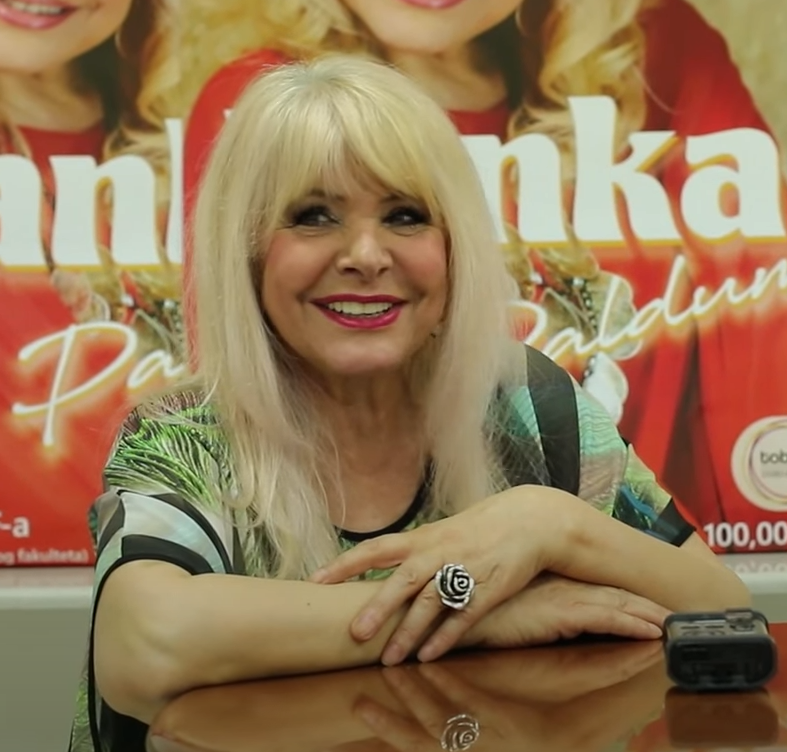
Hanka Paldum (born April 28, 1956 in Čajnič, BiH) is a legendary Bosnian singer of folk music, especially sevdalinka and folklore. During more than four decades of her career, she became one of the most famous and influential musical divas in the Balkans. In addition to being a co-founder of a record company Sarajevo disc, is professionally considered one of the best interpreters of sevdah of the 20th century. Her capricious voice and emotional performances earned her the nickname ‘Queen of Sevdah’, and the audience of all generations regularly sings with her biggest hits.
Early life and career start
Hanka grew up in Sarajevo, let alone as soon as her family moved from her native Čajnič in 1963. From an early age, she sang in the school choir and at performances, especially listening and performing sevdalinka independently. At only 18 years old, she spoke at the audition of Radio Sarajevo, where she recorded the first records – traditional sevdalinka, among which the first was ‘My Beharu, who are you picking you’. After winning the Amateur Festival Let’s sing the Day of Youth, Hanka also recorded the first single ‘By the way of the road after the birth of the apple’ in 1975 for the Sarajevo discoton.
The early phase of her career was marked by several more singles (e.g. ‘Ljubav žene’ and ‘Burma ču tvoju tjeru’ accompanied by TV Sarajevo) that strengthened her on stage. The success of the song ‘Zelene oči’ (compositor Mijat Božović) launched it among the stars of the former Yugoslavia. After a long-term relationship, she married musician Muradif Brkić, and in 1979 they founded their own record company together Sarajevo disc. The move allowed her to have a greater impact on her own career and music production in the region.
Climbing on the scene – the greatest hits and albums
The end of the 1970s and the beginning of the 1980s was Hanki Paldum extremely successful. The song ‘I loved, I loved’ (written for her by Milić Vukašinović) became a big hit and brought it Oscar of popularity for singer of the year. The first album soon followed Longing (1980) whose biggest success was ‘Black Hair’.
Second album I’m dreaming (1982), also under the baton of Milić Vukašinović, was sold in more than 1.5 million copies – An impressive result even for the then huge market of the former state. After that, Hanka continued to regularly release albums and singles, collaborating with famous authors (eg Perica Simonović, Ibro Mangafić) and the South Vetar ensemble. At the end of the 1980s, she had several victories at festivals – for example at the festival in Vogošća with the song ‘Bolno srce’ (1986) and ‘Give me a night’s soul’ (1990).
Among her most famous songs are:
- “Green eyes”
- “I loved, I loved”
- “black hair”
- “I remember more”
- “What Every Woman Dreams”
- “No one as a mother”
These songs (and many others) were listened to in several generations – the audience sang them in unison at concerts. Hanka won the hearts of listeners with her hits, and many of them still live as evergreens of Balkan folk music.
War, social engagement even after the war
During the war years in Bosnia and Herzegovina, Hanka Paldum remained in Sarajevo and was an important cultural figure. In April 1992, she performed at an anti-arat protest in front of the Sarajevo Assembly and sang the lyrics ‘Muslim, Serb and Croat, everything is my people’ from her song ‘Bosnia je moja majka’, sending a strong message unity. Despite the difficult times of the siege, she survived in the city – in 1993 she was even a member of the jury of the election for Miss surrounded Sarajevo.
After the war, she continued to perform throughout the region. In 1996, she also held a magnificent solo concert in Zagreb’s Vatroslav Lisinski Hall, confirming her popularity among the audience in Croatia. Later, she regularly came to visits in the region and abroad – she performed in Croatia, Slovenia and even countries like Turkey and the Netherlands. She successfully performed the new album ‘Nek’ je od srca’ (1999) and other projects, while the authors collaborated with big names of the domestic music scene (Hari Varešanović, Alka Vuica, Al Dino, etc.).
Awards and recognitions: For her contribution to culture, she won numerous awards, including the Golden Oscar of Popularity (singer of the year 1979/1980) and a monetary certificate of appreciation from the City of Sarajevo (2004). During her career, she was often awarded at folk music festivals and had a whole constellation of recognition from expert juries and audiences.
Hanka Paldum Today: Concerts and Media
Hanka Paldum remains very active today. He performs on tours in Bosnia and Herzegovina, Croatia and beyond, often full of halls thanks to his long-standing loyal audience. For example, in January 2024, she held a sold-out concert in Nedelišće (not far from Čakovec, Croatia), where she performed her biggest hits in front of enthusiastic fans. As reported by Dnevni avaz, the ‘queen of sevdah’ was in an extremely good mood on that occasion, and the audience of all ages sang all the songs with her.
In addition, Hanka also appears on television projects. In the fall of 2023, she became a member of the jury of the popular music show ZMBT (Hayat TV), together with Enes Begović and Fahrudin Pecikoza. With this, she managed to bring her talent closer to new generations, influencing as a mentor of young singers. In recent interviews, he emphasizes that he still enjoys traveling and concerts around the world. In the past year alone, she held a series of successful concerts in Bosnia and Herzegovina, Croatia, Turkey and the Netherlands, and although she worked actively, she remained modest – as she said, when ‘the lights go out’, she is an ‘ordinary woman, mother and grandmother’.
Style and legacy: Hanka Paldum is most often described as a very approachable, modest person, which further strengthens her status as a favorite singer. Her stage performance and sincere relationship with the audience are often highlighted in criticisms and statements (such as that the audience ‘filled with heart and love’ feels special energy during performances). Due to its comprehensive musical contribution and evergreen collection, the audience and critics call it ‘the giant of sevdah’ and ‘the legend of folk songs’.
Conclusion – call to action
Hanka Paldum remains an indispensable voice of Bosnian and regional folk music. From modest beginnings in Sarajevo to a full hall and television screens, she built a career rich in successes and a warm relationship with fans. Her ‘biography’ tells the story of her dedication to traditional art and the ability to adapt music to all weather conditions – from sevdalinka according to the old recipe to contemporary arrangements and talent shows.
We invite readers: If you are interested in more about Hanka Paldum’s life, listen to her hits or watch her performances on YouTube and streaming services. Also follow the news about concerts in your city – you may experience the magic of her song live! Share your favorite Hanka Paldum songs or concert impressions in the comments; We are happy to hear your stories about that sevdah legend.
Sources: The data in the article are supported by interviews and news from the region, as well as official biographical notes describing Hanka Paldum’s long career. We created this story by careful research of available sources in order to offer readers a complete and credible insight into the life of one of the most famous singers of our region.