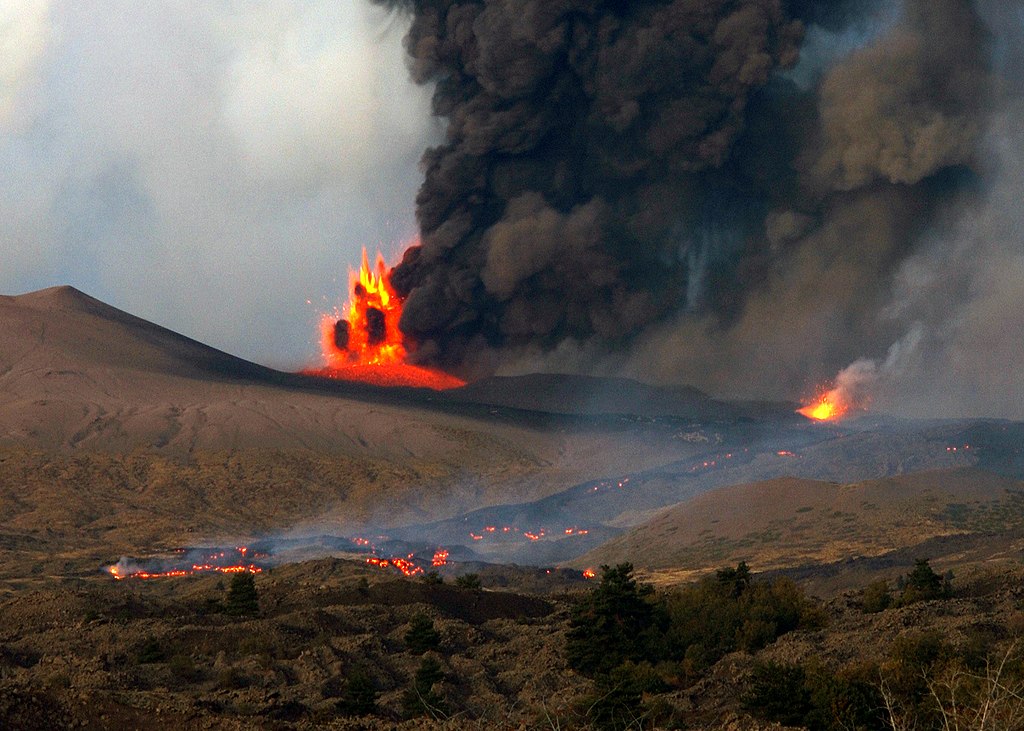
Etna rises majestically over the Sicilian plain. From a distance, the mountain appears steadfast. But the facade is deceptive. Beneath the surface of Europe’s largest active volcano, things are churning hard.
It could erupt at any moment. Despite this – or perhaps because of it – tourism on Etna has been booming for years. Climbing the smoky craters at the summit is one of the most impressive experiences of a trip to Sicily.

Gloves and a hat are a must. Although the sun has been warming the eastern coast of Sicily for days, there is no sign of it on the cloud-covered mountain. At an altitude of 1,900 meters above sea level is the Rifugio Sapienza, the central meeting point for tourists visiting Etna. From there, a cable car departs that transports visitors and hikers close to the crater.
Avoid tourist scams
Although the rocky, dusty landscape surrounding the large parking lot could hardly be more deserted, the sanctuary is like a fairground: souvenir and postcard vendors, bar owners, and self-styled tour guides compete for the attention of wealthy visitors. Those who want to avoid tourist scams are best advised to book a professionally guided tour in advance.
First, a cable car and off-road buses take you through the cloud cover to an altitude of 2,700 meters – straight into a sunlit rocky desert. This is where the paths of ambitious mountaineers and panoramic tourists diverge. Those who have not signed up for the tour will have to content themselves with admiring the Nuovi Coni – small craters newly created by the eruption in the winter of 2002. The group led by Swiss mountain guide Andrea Ercolani, on the other hand, heads towards the central crater at an altitude of 3,300 meters.
Uncomfortable balancing act
The first stage leads over a gravel road of cooled lava rocks. As the group balances awkwardly on the black, jagged ground, Ercolani gives an overview of the volcano’s history: Four major craters have erupted into the mountain over the past millennia. New eruptions constantly create new craters, and their rims never last long. Therefore, the height of Etna cannot be measured to the exact meter. The figure could be outdated just a day later.

So far no rumbling is heard. Only the icy wind whistles around the ears of the mountaineers. The way to the top is tiring, but the view of the Sicilian interior is worth the effort: On a clear day, the view stretches from the Tyrrhenian Sea in the north to the Ionian Sea on the southeast coast of the island.
The air is becoming thinner.
After a three-hour climb through the gray lunar landscape, the air is getting thinner. Sulfur seeps from every crack in the ground, the wind blows harder and harder, piercing unprotected areas of the face like knives of ice. “If we now reach the crater rim and you hear a bang: Don’t panic!” shouts Ercolani. “Put your backpack on your head and descend slowly! Don’t run!” The tour of the crater rim is otherwise not dangerous, explains the volcano guide.

It is connected by radio to a seismological monitoring station that records every tremor of the mountain. Larger eruptions can be predicted in advance, but rocks suddenly ejected from a smoky crater could be unpleasant.
Breathtaking view
The view into the crater is literally breathtaking. The numbing stench of sulfur eats away at the cloth we’ve brought as face masks, burning our throats and taking our breath away. Ercolani rolls a rock down the slope, which after a short while disappears into the volcanic mist. At some point, there’s a dull thud. The explosive mixture doesn’t seem particularly far away. Ercolani urges us to hurry; we shouldn’t stay too long. Half the group is coughing. The mountain air up here is certainly not healthy.
The descent turns out to be easier than expected. After a break in the lee of bizarre lava formations, the trail continues past another crater to an ashy-gray sandy slope. “You can ski now!” shouts Ercolani, sprinting. “Always fifth first!” Indeed, the 600-meter climb can be covered in just a few minutes using the freestyle technique. A short time later, the shelter is reached. There, the next excursion is already being planned: They should get back to real skiing – there is snow on the north side of the volcano until June.
Cover photo: US Navy, Photographer’s Mate 3rd Class Richard W. Williams , Public domain, via Wikimedia Commons