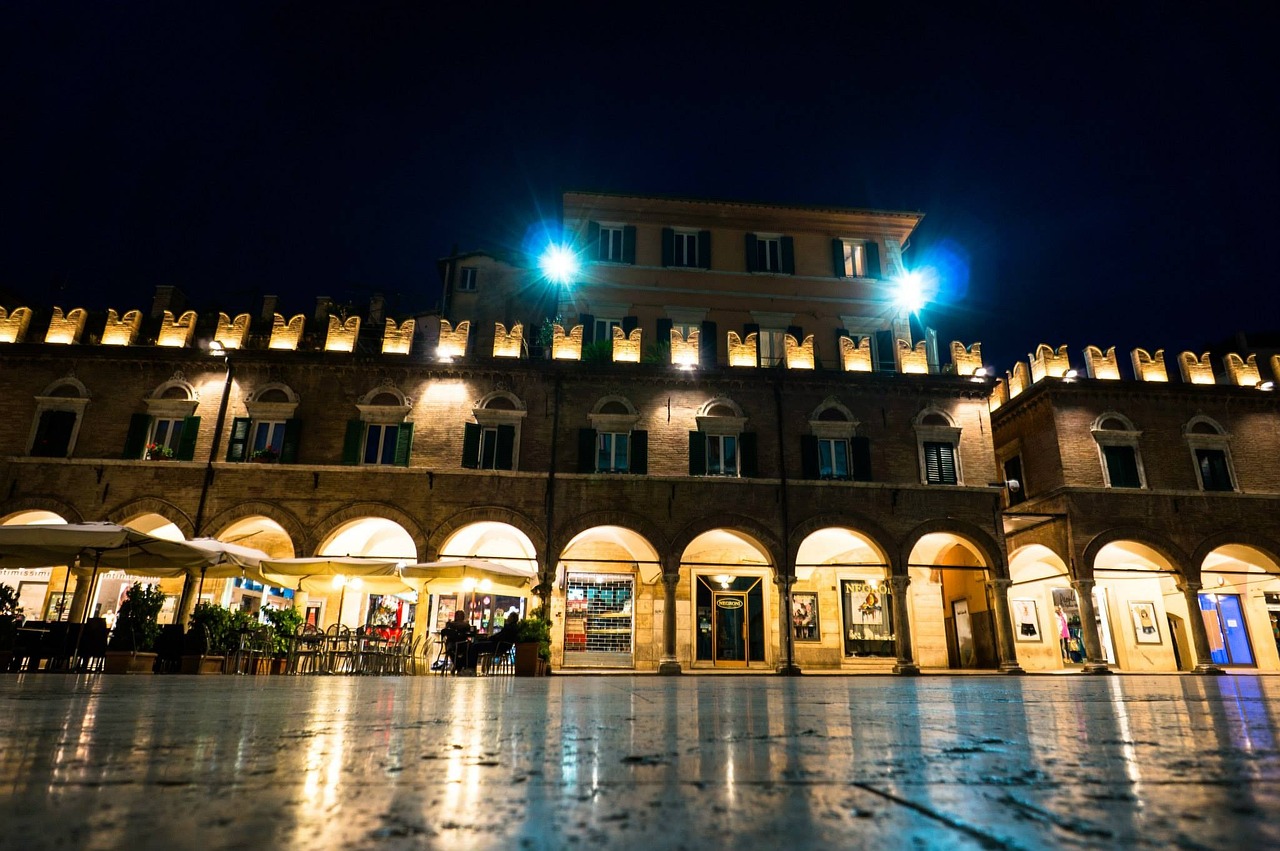
Walk around Ascoli Piceno, and in a way it could be any Italian city. There are two big squares where the locals watch the days pass, sit in cafes to watch people and do their night walks Paseggiata . There are centuries-old churches and even ancient remains dating from the Roman period. As in many other Italian cities, the center was built in the Middle Ages. And, like the others, it is beautifully preserved. But wander around – especially at night – and you will notice one big difference: Ascoli seems to light up.
During the day, buildings and even paved stone shine in sunlight. And at night they shine in the moonlight, towers, porches and street lights are perfectly reflected in the floors, making the city center like a mirage. This all boils down to the fact that Ascoli’s local rock, from which the entire historic center was built, Travertine: A precious stone, similar to a marble, which shines in the midday sun with a white bone, blushes pink with sunset and shines under the evening street lighting.
Today, travertine – and especially Italian travertine – is expensive. You will find that it is used in bathrooms and as a floor, instead of being used to make whole houses. But Askoli’s travertine buildings and paved stone were installed long before it became an ultra-precious material. Many magnificent buildings that you see today date back to the Roman period.
Miniature Old Rome
Or rather, they were reworked from Roman buildings – which is why you will find churches that balance on visible remains of Roman temples, and pieces of arches and capitols integrated into medieval and Renaissance palaces. The Romans were not the first to be here They settled, says Lella Palumbi, a tourist guide to Askoli. The city originally belonged to Picena – an ancient tribe whose territory spread over most of the modern Marche region, from Pesaro in the north to Chieti, in modern Abruco. They founded the city for centuries before Rome was created.
The Picenes were great warriors, says Palumbi, and the Romans, becoming increasingly powerful, quickly sought to become allies. But Piceny’s demand for Roman citizenship caused a one-year war, which culminated in the capture of Ascoli. When they entered, the Romans razed the city to the ground and decided to rebuild it from scratch. calcium carbonate. It is known to be porous – almost elastic – thanks to external organisms such as algae, moss, bacteria – and, often, fossils.
The Romans had already used it for their most important buildings and monuments in Rome, using quarries in Tivoli near the city — they even called it ‘Lapis Tiburtinus’ or ‘Stone from Tivoli’, which was later corrupted in ‘Travertino’. “After conquering the Askoli, the Romans noticed that there were similar quarries a few miles away, near ancient Via Salaria. They used that stone to build a shiny new city, to demonstrate their power even over enemies who are Mostly worn out in battle. It was, says Palumbi, ‘miniature Rome’. There were temples, court, spa and capital. One square, Piazza San Tommaso, is still slightly rounded today because it is located in the ancient The amphitheater, just outside the city center, are the remains of a Roman theater — one of the few ancient buildings that survived the medieval ‘recycling’ of the city.
2,000 years of upcycling
The Roman Ascoli lasted far from the time of the Empire, but in the Middle Ages, the citizens decided to rebuild themselves. Instead of using new stones, as it might now happen, they rebuilt Roman buildings, using travertine felling 1,000 years earlier to build a modern city. Today, the churches of San Venanzio and San Gregorio Magno are located on the site of Roman temples, installing their stones in a building — the latter even recycled pagan foundations, its back wall and even built its facade around two original Corinthian columns.
‘Everything is recycled – we dismantled Roman monuments to build a medieval city,’ says Palumbi, who also owns the Ozio bar, which is located in a medieval Roman stone building that has been renovated in Renaissance.’ They tried to save time and energy, so instead of going to the mountains to take out travertine, they took what was already – the city was essentially a quarry.’ Look closely at the many towers that made this the medieval Menhatna (Ascoli is sometimes called the ‘city of 100 towers’), and you will see many carved Roman slabs, she says.
The city underwent more restylation during the Renaissance period — still exclusively using travertine — which made Ascoli Piceno a button of architectural heritage that has never changed.’Ascoli is the only city in the world made entirely of travertine,’ says Stefano Papetti, director of five museums in the city in the role of Askoli’s scientific advisor for city collections.’Different from other Italian art cities – they were mostly built of brick, and then ‘trained’ with travertine or marble. But here, whether it is Roman, medieval, Renaissance or later, all buildings are made of solid blocks of travertine, extracted from the mountains around Askoli.’
Wes Anderson Style Change
Today, Ascoli Piceno is home to the highest concentration of Romanesque churches in the center of the Italian city. It is said that the sixth-century baptistery is one of the best examples of its kind in the country. The Pinacoteca Civic Art Gallery in Askoli has the works of Titian, Guido Reni and Carl Crivelli — a Venetian painter from 15th century who worked in the Marche region and died in the city. And his most famous bar, Caffe Meletti, was created directly from Wes Anderson’s film with his Baby Pink facade, mint green tables and luxurious interior in style secession. Its anise liqueur was tried by everyone from Ernest Hemingway to Simone de Beauvoir. The city is even known for its food. ‘Ascolane from olives’ — too big, juicy olives filled with meat and fried — are eaten throughout Italy.
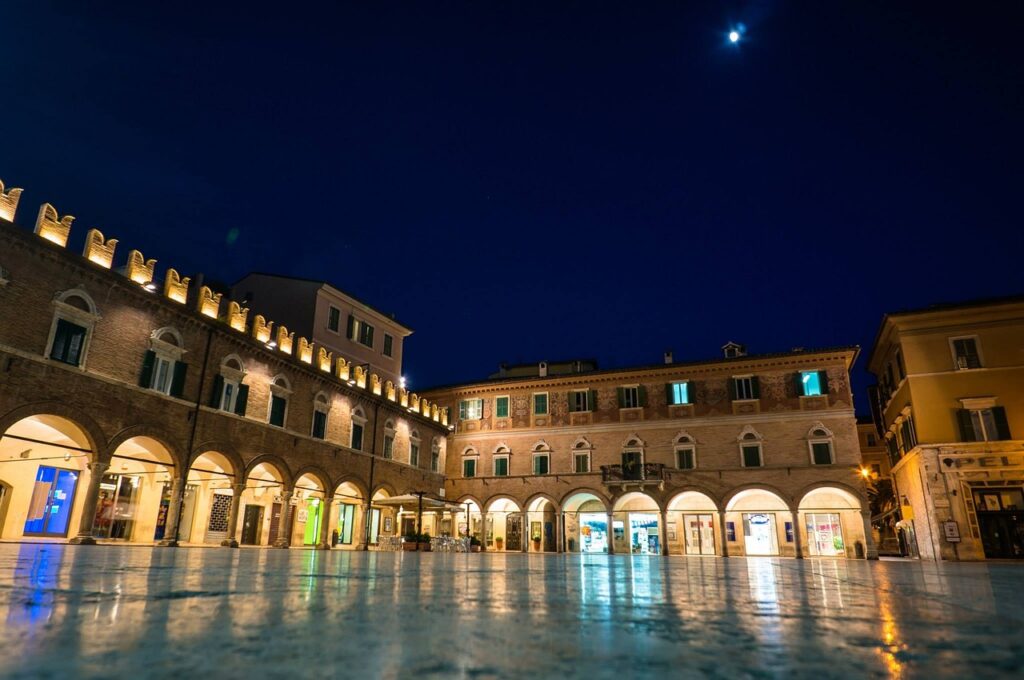
However, few things can compete with the buildings of Travertino Ascoli Picenoa.Piazza Arringo, the cathedral square, is surrounded by magnificent Renaissance buildings — including the 12th-century town hall, where the art gallery. The old gentlemen sit on the travertine benches outside and watch the water erupt from the mouth of two bronze seahorses in the fountain opposite. The fountain itself is, of course, a travertine. To enter the city, you walk or drive over a Roman bridge, built from travertine. Meanwhile, Piazza del Popolo, the second main square, is surrounded by Renaissance buildings — the area was renovated at the beginning 1500s.
Travertine porches hide medieval actions that were considered insufficiently harmonious for the Renaissance. One side of the square is completely occupied by the church of San Francesco, which is said to be one of the best Gothic buildings in Italy. On the other is the Palazzo dei Capitani, together with the tower — a trap-like building, which is now used by local authorities, which holds regular exhibitions and provides access to the Roman market in the basement. Fully paved with travertine, this is a square that shines at night, When a skillfully installed street lights make it look like the porches melt into the ground, the palace floats, and the whole place looks like a shining mirage. ‘It’s beautiful at night with lighting,’ says Papetti — who adds that Askoli, in fact, changes every day.’ Travertine has this quality that changes color depending on the sun and weather,’ he says. ‘It can be very warm—for example, it can blush in the sun. It turns gray in bad weather.’
The stone that saved the city
Travertine has another special quality that gives Ascoli’s beauty. When it was first taken out, it is relatively soft, which allows it to take shape — one of the reasons why Askoli’s buildings have carved portals and facades — many Renaissance houses even have motos carved at the door. Then, through The chemical process of oxidation, hardened into a rock so resistant that the Ascoli buildings suffered multiple earthquakes over the course of the century. Razor amatrice , an hour away.
Of course, Amatrice was closer to the epicenter both times — it was also destroyed in 1703. The terrain is also different — Askoli is more stable than other nearby areas. But, says Papetti, ‘the stone helps to make buildings more stable.’ Palumbi agrees: ‘The Romans were aware of the earthquake and built the Askola to resist them. They had better engineers than today.’ We could still live happily in Roman houses to have them We did not collapse.” Although the 2016 earthquake caused damage — several churches were closed due to structural repairs, and research after the earthquake revealed that other buildings needed anti-seismic work — nothing was destroyed, as was the case in other cities in the region.
Ascoli’s ‘All’
For centuries, Ascoli’s Travertine quarries — located in three areas around the city — were a key part of the city economy. Builders in the medieval and Renaissance periods used Roman quarries on Via Salaria. But in the 20th century, quarries opened in the hills around the city — especially on the Colle San Marco, rising behind the city on the border with Abruco. In the post-war period, about 15 quarries emerged. The father of Đulijan Đulijani opened one in 1952. His family was so preoccupied with its quarry that it likes to say that it was born in it. ‘I played on stones as I grew up,’ he says. ‘I live in a travertine house and I walk on a travertine every day.’ The quarry was closed in the late 1980s, along with others in that area — partly due to the economic crisis, partly due to the Environmental Protection Act. But Giuliani kept him.
Today he is a sculptor. And of course, vaja in travertine — mostly blocks from his father’s quarry that were cut before closing time. Sometimes he buys a stone from a quarry that still exists in Acquasanta, west of Ascoli. And he describes working with travertine as a ‘spiritual experience’. Fossils. It’s a stage, tells the story for thousands of years.
Papetti, who is a fan, says that Giuliani can make the stone ‘soft as a sheet of paper’. This is all about the ‘elasticity’ of the stone, says the artist. ‘When I decided that I needed to be an artist, I chose the stone I grew up with — partly because it inspired me, but also for technical reasons, because it allows me to make very light sculptures,’ he says. His works — thin and transparent, with that almost impossible paper quality mentioned by Papetti — are shown at the Venice Biennale, the Milanese Design Week, and the Italian Expo 2015. His clients vary From Pink Floyd’s Roger Waters to the Vatican, yet the humble heroes of Đulijani are, as he says, ‘unbelievable’ people who used to separate huge stone blocks from the mountain. The quarry, enveloped The trees of chestnuts and oaks that stand 2300 feet above the city are his studio. He even has plans to open a ‘travertine school’ where people from all over the world could learn to process stone. What would Ascoli Piceno be without Travertine? ‘Nothing,’ he says. “Travertine means everything.”
Cover photo: Image by Philipp Ruch from Pixabay